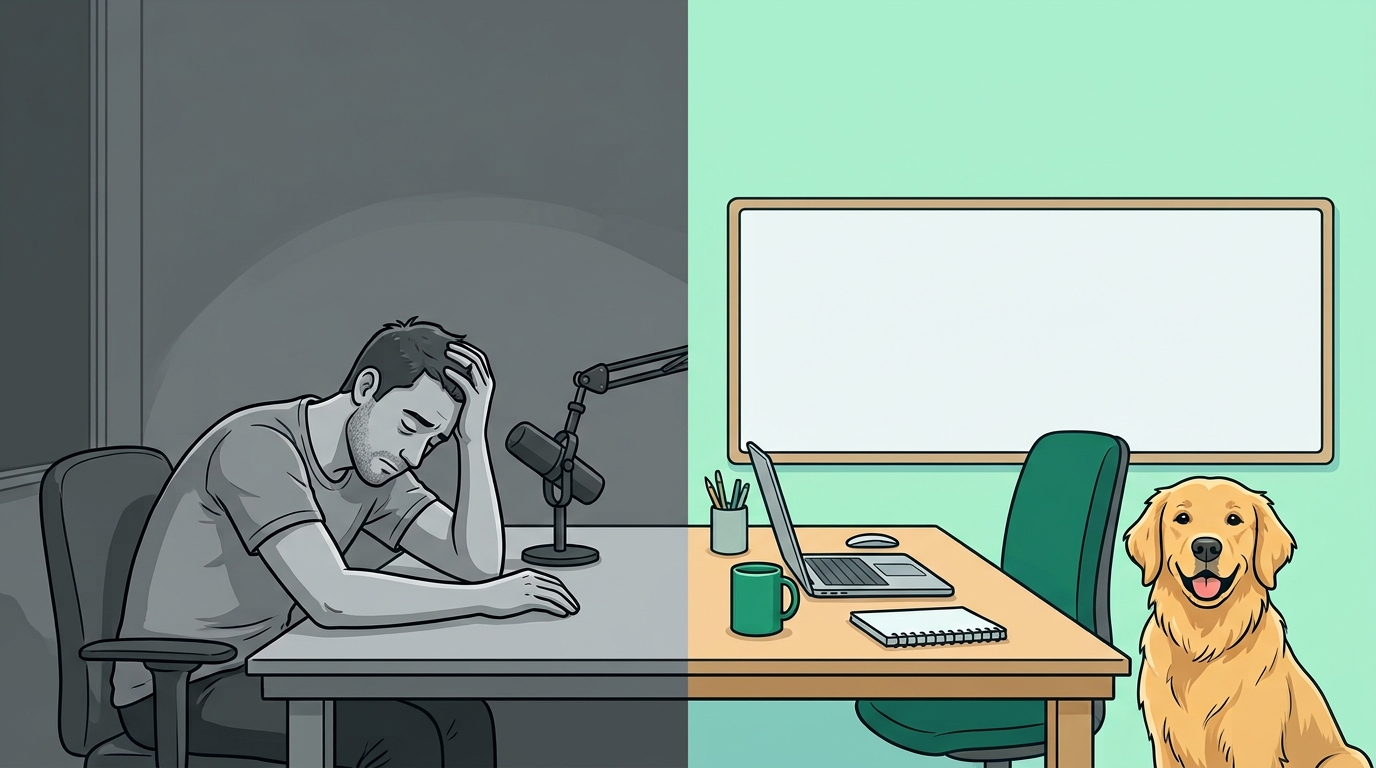
How do you stay consistent with your podcast when the motivation runs out? You build a system that keeps going without it. Some weeks you record three episodes before lunch, and other weeks one rough night wipes out two days of work. When your show only moves on the good days, the bad weeks stall it, and that stall is where most podcasts die: 44% never make it past episode three.
In this episode we walk through PodcastOps, the operating discipline that runs your show the way a business runs operations. We cover its five principles (systems beat motivation, make the work visible, batch by mode, measure what you control, and review on a schedule), then six steps you can start this week, from mapping your stages to banking a one-episode buffer.
CHAPTERS
Why motivation fails
What is PodcastOps?
Systems beat motivation
Make the work visible
Batch by mode, not by episode
Measure what you control
Review on a schedule
Start PodcastOps this week
LINKS
Full show notes: https://thesteadypack.com/blog/2026-10-11-podcastops-run-your-podcast-like-a-system
Batch-recording pipeline: https://thesteadypack.com/blog/2026-03-08-batch-recording-mastery-how-to-record-a-month-of-podcast-content-in-one-day
Podfade is a systems problem: https://thesteadypack.com/blog/2026-05-31-podfade-is-a-systems-problem-not-a-motivation-problem
Newsletter: https://thesteadypack.com/newsletter
Unleashed Podcasts (meet Daisy, your accountability coach): https://unleashedpodcasts.com/
Transcript
 Scott Keck-Warren
0:05
Scott Keck-Warren
0:05
So if you're anything like me, some weeks you just feel it. Your ideas are flowing and you crank out 3 episodes before lunch. But then the next week arrives and that spark is gone because you had a rough night, so you get zero done in 2 days. Your show's survival is dependent upon your mood, and mood isn't always something you can plan ahead for. Podcast Ops fixes that by running your show the way businesses do, with repeatable processes and a pipeline you can see, so your podcast stays consistent on the weeks where you don't feel it. The gap between good and bad mood is where podcasts die. Research has found that 44% of podcasts never make it past episode 3, uh, and shows stall or pod fade not because of lazy or untalented people, but Because they lack an operating system. On this episode of the Steady Pack, we'll talk about podcast ops and how you can implement them for your podcast. Unfortunately, motivation is inherently unreliable, as any of us adults know. It spikes when we're working on something new and then fluctuates with your energy and based on the feedback you get. I mean, who hasn't felt discouraged after getting just 2 views from your mom? Content creators build their entire output on top of motivation, and it's the one input that they can't control. When a content creator has gaps in their output, it's not a lack of willpower. They're the predictable result of running on a fuel that runs dry when there are challenging weeks. So every business that succeeds does so because it runs on operations. This means they have a repeatable process, a visible picture of what's going on, and a regular review of everything that's going on. The business can't rely on whether the team felt inspired. They need a system to move work along. Podcast Ops applies that same concept to podcasts or any other type of content creation. Being a successful content creator isn't about wanting it more or working harder, and it isn't a personality trait you do or do not have. It's having a set of processes and principles that make the next piece of content the path of least resistance. So it's the fuel and not your fickle motivation. We at The Study Pack talk a lot about systems over motivation, and this is where the rubber really hits the road. So Podcast Ops is controlled by a few different principles. Uh, the first is that systems beat motivation. Systems are easy. You design a workflow once and then you just follow it. Instead of waking up each day and negotiating about whether today is the day you record, you have a process and a scheduled time to do it. This removes decision fatigue because you've already made the decision back when you had energy and not when you wake up with a stuffy nose. Motivation might still show up, and it's a huge bonus if it does, but the system doesn't rely on it. Next, we want to make the work visible. One of my old bosses had a rule that you can't run a process you can't see, and every episode you create moves through stages. You have an idea, it gets scripted, recorded, edited, and scheduled. If the only place that you keep track of an episode's status is in your head, you're gonna lose track of it. You'll forget which episode is scheduled and which one is still in need of some editing. One week everything will flow perfectly, and another you'll realize nothing is ready to be published. Put this date somewhere you can look at it and update it easily. A spreadsheet, a board, a scrap of paper, anything that shows you at a glance what's going on with each episode and that will keep you up to date. Visibility turns a pile of intentions into a pipeline that you're actually managing. The next is batch by mode and not by episode. So your brain has gears and switching between them has a non-zero cost. If you're multi-creative, your gears might be set up for writing, recording, and editing. When you produce a single episode from start to finish and then start over on the next one, you're gonna be grinding those gears as you switch those processes. We recommend that you batch tasks based on what gears you need engaged to make everything easier. This is where our batch recording pipeline comes in. Um, and you can relate this to a physical space as well. If you're doing a full episode every time, that's a lot of setting up of your recording space and getting camera ready. If you batch your recording, you minimize how often you do that and reduce the chance that you forgot to brush your teeth. Next, measure what you can control. Unless you're already well established when you start your podcast, the download numbers are gonna break your heart. You can't move them much, and they'll tell you nothing about whether your system is working. Instead, track the things that you can control: episodes published, weeks in a row without a missed episode, and how many scripts were written. Those are numbers that are inside your locus of control. Then reward the input. Daisy, the dog, would tell you that you don't get treats for almost staying, you get treats for staying. The final principle is to review on a schedule. Having a process that isn't working is just as bad as having no process at all. You must conduct reviews of what's working and what's not on a fixed schedule. We recommend every 2 weeks, but don't feel constrained by this. If there's a flaw in your process and it's glaring, like a missing stage, it should be fixed right away. I would ask yourself these 3 questions: what stages stalled, what got skipped, and what took the longest? And then tweak your process based on your answers. You may not have a perfect answer immediately, but point in the direction that you think you need to go. So starting podcast ops this week is as easy as 6 little steps. First, write down each of the stages your content goes through. If you're not sure where you can start, you can steal our stages on our website. Then put an episode on a content calendar or a Kanban board. This will give you the visibility into where each episode is in your stages and where you need to focus. Block your calendar for the various stages so you can batch them. This will keep your brain from switching gears too often and overestimate it so you're not time constrained, which To be honest with you, it's terrible. Get one finished episode in the banks, which is gonna be your buffer, before you publish the next one. When a rough week hits, you publish the buffer and use the extra week to reassess instead of scrambling. Choose a number you can control, like scripts written or weeks in a row without a missed episode, and write it down every week. And then finally, put a date on the calendar 2 weeks out to ask what stalled and what got skipped and what took the longest, so that you can then fix the processes. When Podcast Ops runs your podcast creation, a bad week stops being a threat. If you have everything running, all of your scripts will be written when you're ready to record them, and then a rough Tuesday doesn't result in your podcast joining those 44% of podcasts that don't make it. The system will carry you through the stretch where motivation can't. It's important to consider that creators who don't pod fade aren't more disciplined than you. They just built workflows and processes, so publishing the next episode is simple. That's the core belief this whole brand runs on. You don't need more motivation, you just need a better system. Podcast Ops is the name for building that system. If you want more systems like this, make sure you subscribe, um, as well as like, comment, and share the video as it does help other people find us. Thank you for your time.