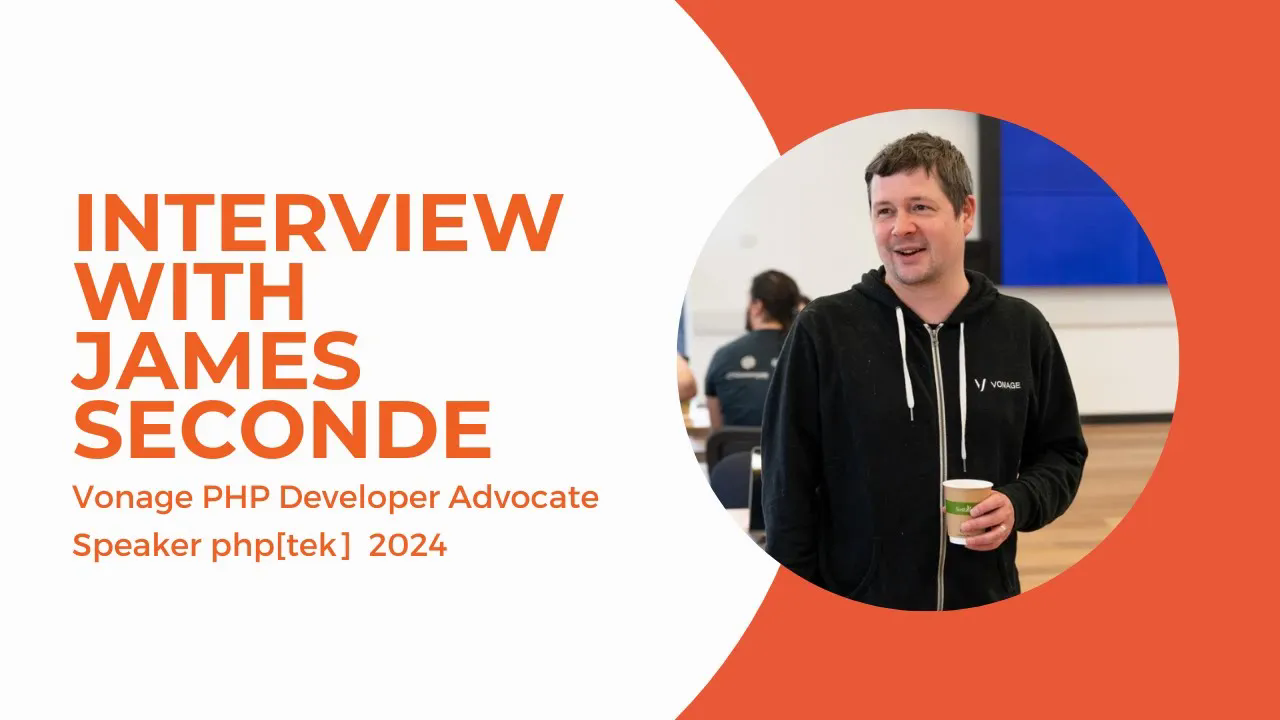
In this video, Scott talks to James Seconde about what services Vonage provides developers and his talks at php[tek] 2024.
Links:
Tickets to php[tek] 2024 - http://tinyurl.com/tek-2024-tickets
00:00 Intro
01:01 Theater Studies to Dev Relations?
10:41 What services does Vonage provide developers?
13:46 Silent Authentication
16:07 php[tek] 2024
17:05 What are your talks about?
23:37 Outro and plugs
Transcript
 Scott Keck-Warren
0:05
Hello developers, and welcome to the PHP Architect Community Corner, where we have conversations with members of the web development community. I'm your host, Scott Keck Warren, and on today's episode, we're gonna talk to James from Vonage about his experience going from a theater major to a dev relations person, what we can learn about Vonage as, and use as developers, and his 2 talks that are going to happen at PHP Tech 2024. A trained actor with a curious background from theater studies to QA to business intelligence development, all the way up to full-stack development, James Second is the resident specialist PHP developer advocate at global cloud communications giant Vonage. He founded Birmingham, UK's current PHP user group, BermPHP, as well as being on the Fusion meetup team. He mentors, writes, and speaks on PHP, JavaScript, DevOps, dev relations, and tech culture. James also pretends to be a DJ on the way. Thanks, James, for finding some time to be with us today.
B
Speaker B
0:58
No problem. Thanks for inviting me.
Scott Keck-Warren
1:01
So I have to really quickly ask you about how did you go from theater studies to dev relations?
B
Speaker B
1:06
I think everybody, everybody in developer relations, a lot of people I know that end up in developer relations, quite a lot of people, especially in the sort of DevOps space, have quite colorful backgrounds. And a lot of the time it involves— you get sort of strange backgrounds like this. I mean, for instance, straight off the top of my head, Salma Alam Naylor, who's very prevalent in— she's at Century or something like that, or one of the others. I can't remember. And she was a music teacher. And so, there's this whole teaching as part of developer experience and developer relations. So, yeah, I'm a trained actor, but was a— this shows how sort of '90s it is— a computer geek. And, well, much to the disappointment of my parents after they bought me a computer, mostly just sort of hacked an old Apple Performer to pieces and went into ResEdit and started mucking around with resource forks and things like that. So trained in acting, went to university and got a degree in— my degree is in English literature and theater. My dissertation is in stand-up comedy specifically. I interviewed a couple of people, including from America. I interviewed Bill Bryson, the travel writer, who was very funny. A lot of it is manifesting how I do talks now. I'm inspired by quite a lot of those stand-up comedians. And that, as I now find out after a successful talk in the UK last week, people either love that or hate that. But when I arrived in— when I moved to London, I just, you know, I wanted a theater job, but I needed to pay the bills. So I just went to like a temping agency that just sort of, you know, you start off doing, you know, going into an office and stamping paper or doing photocopying or something like that. And I think, I mean, the job market was very, I mean, this is 2006. I think it was very different back then when they spotted that I had this sort of, my CV resume had like sort of computer stuff on it. And so they hired me as an Oracle QA tester. And I hadn't touched a line of SQL before. I'd only been doing, I'd only been coding in A lot of HTML and CSS and then HyperCard, which is for the old Mac heads back in the day. I ended up doing a lot of SQL and then a lot of VBA. It's not the most fun I've had. I had a tech career and a theatre career. I did actually work theatre at the same time, so I did 2 jobs in London. Classic kind of LA, New York, London, Paris, take your pick of cities where people have 2 jobs and work themselves to the bone. So I became the technical manager of a fringe theater and also I was doing SQL QA. And then I ended up being promoted and then I started doing business intelligence development, did some bits of Java with SQL, and then thought I wanted to be a full-stack developer really, because I was going— what happened, I started going to conferences. And they paid to send me to conferences and it was all space age. I mean, Docker had only just come out and people were talking about loads of sort of, talking about the fast rise of sort of AWS and things like that. And in my small company, it was just, it blew their minds really. And no one really knew what it was. We had like sort of, you know, old on-premises Microsoft services. So my career wouldn't go anywhere. So yeah, I went to just, Chose PHP because I was like, well, people are doing this. So I went to a startup, became a full-stack developer, and then I've done about 3, 4 roles of full-stack dev. So when it came to arriving in developer relations, I realized, I sort of took a step back and realized I had to, I rebooted my city's PHP user group because it had gone dormant and it just happens for reasons. So I ran a user group and then I spoke at the user group. And then I spoke at other people's user groups and then I was doing mentoring and teaching people like PHP. And so with all of those things all in mind, one day someone says, do you realize you do developer relations? And I'm like, I don't even know what that is. And it turned out I was just doing that. So all of that has culminated in the fact that, you know, my last 2 jobs have been effectively that. One was heavy in the Laravel ecosystem with a Laravel partner and now I'm at Vonage where there's a lot of, you know, I try and balance it between Symfony and Slim and Laravel, but I do a lot of outreach, writing, mentoring, that sort of thing. It's a strange journey. Also, the important thing about my bio that you got slightly wrong is I'm not a DJ, I'm a failed DJ. Or I gave up because I was— It was a lot of effort for, for zero satisfaction.
Scott Keck-Warren
6:28
That's fair enough. I'm always really fascinated by how people come into technology. There are so many paths, right? Like I went through the university college route in the United States and then became like a programmer that way. But then there's always, you know, I'm always fascinated to hear like, oh, like, you know, started out doing this and then I switched over to that. So it's always really interesting to hear that kind of information back. Um, and it sounds like being a theater major probably makes you a better presenter because you're used to being up in front of crowds and being in front of people.
B
Speaker B
6:58
It's sort of a, I don't know, I think it's a sort of a blessing and a curse. You obviously, anyone that wants to go for any audience members in a meetup or usually a conference that wants this quite hardcore specific learning of like of some major concept, they don't want an entertainer on stage. And some of my talks are, some of my talks, I suppose, you know, we'll get to those later. But some of them are, some of the talks I do are pretty straight-laced. I mean, the biggest one I originally did in my last job was hooking up Docker and Xdebug and PhpStorm, and that was it. And it's just technical. You can try and shoehorn a bit of comedy into it. The talk, the 2 talks that I'm giving at PHP Tech are very, very different. They are complete polar opposites. So sometimes it's good to have the entertainment factor, which I play on. It's one of those things where I don't get nervous when getting on stage because I don't care because I'm trained in acting. So I'm happy doing one of my first talks I did in a pub in Worcester in the UK with my brother in the audience, and there were 7 people in there. And I'll give that the same amount of energy as if there are 1,000 people in the room. Don't really care. It's the same. It's all the same to me.
Scott Keck-Warren
8:20
I think that there is definitely like a, you know, a learned component to presenting in front of people. Like, because a lot— I have been in presentations or in, you know, sessions where the person just kind of drones on and it's as boring as all get out. And so I think like having just somebody who has that kind of background might help improve like the talk, you know what I mean?
B
Speaker B
8:40
Yeah. I mean, it's— I think so far with a lot of things, it's been mostly positive feedback, but as you're as your profile gets bigger and bigger, suddenly you have to start switching off from the internet because everyone's got opinions and some of them are not very nice. So I've started getting to that stage where I just sort of shut off a little bit. The way that I angle things is very much to do with the education and the harmony between education and entertainment or engagement. That's kind of my whole sort of USP of What I do on stage.
Scott Keck-Warren
9:16
I always find it interesting, like, getting the feedback from people, and some people will say this was too basic, and some people will say this was too advanced, like, for the same session even.
B
Speaker B
9:23
That always happens. You can't, you can't, you can't please, uh, you can't please anyone.
Scott Keck-Warren
9:30
No, I, that's what I figured out is I'm like, I just, I'm gonna do what I do, and as long as most people are like giving me, you know, positive vibes, I'm, I'm in good shape. So.
B
Speaker B
9:39
There's this, there's also what we, you know, in advocacy, what we call the, the curse of knowledge as well, which you always say. So every time we write a, um, Every time we write an article, you have to assume that people don't know things. I'm dealing with support tickets that come in through the SDK that we have, the PHP SDK, and people still don't know what Composer is. And so you think, well, if I'm going to get on stage, I have my audience for generalist PHP conferences, it's just going to be, I have no idea who's in the audience. So you start off, And I think the way that I structure things, I think a lot of people think is, oh, this is going to be quite basic. But in the last talk that I did in the US, for instance, which was at Longhorn PHP, that was on performance-driven development, it started to go into more technical stuff. So you get the trust of the audience where they realize, hang on a minute, you started off basic for people that are juniors and are learning, but you end up in a place where you have the wounds and the pain and people have seen that you experienced. That's the way I kind of do things.
Scott Keck-Warren
10:41
Sounds really fascinating. So, we have you on today because you work for Vonage and Vonage has been nice enough to sponsor Tech 2024. And so, can you give us just like a brief overview of what Vonage is and what kind of services it provides for developers? Because to me, Vonage is my home phone that I had 20 years ago in between that weird time where, you know, everybody had home phones and Then got high-speed internet and then everybody had cell phones.
B
Speaker B
11:08
I'm very sort of focused on what essentially the division does that I'm part of, is developer experience. And that is the API portion of things. So yes, Vonage has this history in the US of unified call centers and things like that. I mean, I don't deal with any of that side of the business. It's predominantly I say predominantly, it's only the API side of things. So there's, in this sort of mantra of software in the modern age, I say the modern age, as in now, in the last 15 years or so, is adopted and not sold, that people build from startup levels to even enterprise, have building blocks of APIs. SaaS or PaaS. That's, you know, software as a service or a platform as a service. So Vonage is what's called a CPaaS, which is communications platform as a service. So we have APIs that, um, that automates sending of SMS worldwide and WhatsApp messages if you have a WhatsApp Business account. Viber, um, there are— there's video integrations. So if you want to put, uh, if you want to build, you know, something into your app where there is a live video service on there, you know, it deals with sort of rooms and sessions and hooks things together. Probably quite a big one for us is now coming into the security space. So we have, we've had the 2-factor authentication API, which is called the Verify API. Our modern version of it, you can choose what channel you want to use and you can mix the channels up. So you can use, you know, SMS, which is you're getting a text message and putting the code in. But, you know, there's WhatsApp on there, there's email on there, there's a cutting-edge new style, and there's going to be some demos and things that are coming up in Barcelona next week for this, which is silent authentication. If you want to know more about that, come to Barcelona. I'll be probably doing an article and putting the code out soon because I've actually got a Laravel silent authentication with a fallback to SMS app built now. So yeah, with the security, with this kind of security stuff, we've got some Number Insights, so you can get more insights onto the number you're using, what network, how active it is. There's new products being launched in that space, but you will have to wait for the big announcements next week about some of those.
Scott Keck-Warren
13:46
That definitely sounds interesting. I'm really curious about what silent authentication is because that would be huge if, you know, like there was an easy way to do that.
B
Speaker B
13:54
Anyone at PHP Tech, Uh, if you want to see some of that in action, uh, come to the booth and I'll, and I'll show you.
Scott Keck-Warren
14:02
I'll definitely be hanging, hanging out there and checking, checking that out. 'Cause we're working on something right now where we're doing, we're adding two, two-factor authentication to some of our users. And I'd be really curious to see like what other, right now it's just like the Microsoft app.
B
Speaker B
14:14
It's a sort of the, I think, I think the, the, the, the, the way that, the way that we approach outreach and developer experience, you know, in the, in the, in the Vonage team is really, We're helping developers solve problems more easily. That's really— so why would you hand roll a 2-factor authentication system yourself when you can get— you can pull out the— our SDK in whatever language you want? I mean, yes, I maintain the PHP SDK by hand, but we have a Python one, we have a Ruby one, we have a .NET one, we have a Java one, we have Node, et cetera, et cetera. So it's just getting the path of least resistance to use someone else's third-party service. And I think there's some give and take with this that, I mean, our one is if you're going to use it, it's an essential core part of your business and that's it. It's what we do. There's things like, you know, if you want to do, you can use off-the-shelf auth and then eventually you'll probably have to bring it in-house when you're, if your company and your scale and your company gets bigger and bigger. But anyway, that's my talk at Mobile World Congress in Barcelona next week about how how to actually scale up and how you pick and choose your SaaS and PaaS and what needs to be refactored in the future and things like
Scott Keck-Warren
15:29
that. That'd be really interesting. I'm like a big fan of when we get to the, like, we need an MVP and we're just like, okay, what are the 80 services that we can plug into to get us this functionality as opposed to rolling any of it ourselves? Because that's just the way to go, right? Like, even now, like, I'm like, authentication, we'll just have somebody else take care of that. That's Like that's the way to go now until you, like, you hit that point where you're like, okay, now we gotta bring this back in-house and we have a developer who can do that.
B
Speaker B
15:55
Um, I'm doing 2 talks, uh, unexpectedly at ATTEC, but you know, if you want a 3rd talk, I can do the 3rd talk, which I'm doing at MWC. And it's specifically about what you just mentioned.
Scott Keck-Warren
16:07
We'll be right back after this word from our sponsors. Attention PHP developers. Did you know that one of the best ways to improve your skills is to attend a conference? It's true, and have I ever got a deal for you, because PHP Tech is returning for another year of leadership, expertise, and networking all in one event. It's a relaxing atmosphere for tech leaders and developers to share, learn, and grow professionally, while also providing you with the knowledge to solve your everyday problems. You'll learn Xdebug from its creator and how to write sustainable code. So join us April 23rd to April 25th, 2024, just outside of Chicago, Illinois, or online as all of the talks will be streamed live. If you can't make it during the conference itself, all the talks are gonna be available for you to watch later at your convenience. You'll even get access to last year's talks. Tickets are on sale now at tech.phparch.com or use my link in the description to get a discount. Now back to our video. And we're back with James. So James, you're gonna be one of the speakers at PHP Tech. Um, I know you have 2 talks. Uh, I don't, I forgot to look up what days they are, but, but do you wanna talk a little bit about what our listeners and our viewers can expect to hear from those talks?
B
Speaker B
17:17
Okay. Yeah, there's, there are the 2 talks are very polar opposites. I will go through, I'm going to go through the second one first rather than the first one. And I'll explain a little bit about the background of the first one. The second one is on, is on SDKs. So I maintain the, I maintain the PHP SDK for Vonage. But I have to, I have in 15 years of cuts and bruises all over my face of dealing with technology and other people's APIs, I've had the experience that a lot of people have maybe had that are mid or senior or sort of principal architects, which is just dealing with terribleness. And that's the way we structure our SDKs at Vonage is, you know, it has to be best practice. We make sure that we've got best the best in class. Everything I do is test-driven development. We have to work and work with versioning from a developer's perspective because developers are our customers. So, from that perspective, it's very obvious that a lot of SDKs, but a lot of startups who are creating products primarily aimed at developers, in the same way that, you know, in the same way that Vonage APIs are. There's a lot of knowledge gap where the people that have seen it all before are not talking to the people that are building out SDKs. So this talk is all of the dos and do-nots, and here are examples of how to build out an SDK in the same way that I maintained the SDK that I inherited. And I was already familiar with the SDK that I inherited because I inherited it off Chris Tankersley, who I'd been speaking to previously before then, because I took his role as the PHP advocate because he left. And then, and then he came back in a different role. So then I got to hound him about everything else, which is, which is quite sort of an amusing way that ended up. But there are lots of dos and do-nots and it goes into technical detail about how to structure things from a code perspective. There is some engagement in the way that I speak with that, but really that's primarily based on learning for the audience of, look, if you want to do this, you want to make a go of it, here is what I have experienced and here is what you can learn. The first talk is not that at all. The first talk is written as a— effectively, I'm not going to say a stand-up comedy piece because it's not, because you have to be funny in order to do that. It's written as an inspired-by stand-up comedy, specifically 2 British comedians, one probably not familiar from American audiences, one maybe a little bit more famous. The first one is a man from near me in Stafford in the UK called Dave Gorman, and his comedy was very much evolved around using PowerPoint as his main tool and statistics to do his jokes. And the second one is Eddie Izzard, who is very storytelling-driven with the way he directs things. So for the talk on APIs, A History of Miserable Mistakes and Industry mishaps, it's a journey through various terrible things that we've done as an industry. You might, if you don't know the background of how, of the evolution of APIs, might learn something, but really it's written as a collective shared piece for everyone to groan and go, thank goodness we've all been through that. As a sort of hype factor for that, I've been told by my team it's the most unhinged talk I've ever given. Um, someone came up to me after I gave the talk in my hometown and said, are you sure you didn't have a mental breakdown during that talk? Um, just assured, I am an actor, so no, I am fine, but I will make it as engaging and as entertaining as possible. And it's a bit, it's a bit nuts, but it's designed to be a bit nuts.
Scott Keck-Warren
21:41
That's the history lesson in industry makes and mishaps, and that's Tuesday just before lunch, that'll probably be a good like palate cleanser before lunch. Absolutely.
B
Speaker B
21:50
It's, um, it's, it's got, it's got any, hopefully any energy levels that will just bring people up just before lunch.
Scott Keck-Warren
21:56
Yeah. Yeah. I hate, I hate presenting just before lunch. I seem to like always get slotted into that spot and it's always just like, people are like, they look like they're about ready to fall asleep and they're hungry. And so—
B
Speaker B
22:05
I've, I've been sort of, I've been told that really in terms of, in terms of scheduling, it needs to go at the start of the conference or the end of the conference. And then I've been told off by various people within PHP land that really I should have pitched this as a keynote. But there you go. Maybe I should have done that. I don't know.
Scott Keck-Warren
22:21
I'm really actually quite interested in that SDK tuning one. Because we don't provide like an SDK to people. But I'm always— we do consume a lot of, you know, SDKs that other companies have generated. I'm actually working on like an integration with a large company. And the documentation is just miserable.
B
Speaker B
22:39
Oh yeah. That's things, things, things like docs feature fairly heavily.
Scott Keck-Warren
22:43
Yeah. So I think like, that's like the biggest thing for me too, is like, because essentially I'm having to become an expert in the software and then also an expert in the API because like the concepts like fall over and there's nothing in the API documentation that says like, oh, you don't understand what an account type is? Oh, click over here and you can like see that, right? It's just like, they expect you to be an expert in this company's software and then also be an expert in the API.
B
Speaker B
23:08
Oh yeah. It tends to be sort of a Yeah, there's the mixture of horrendous volumes of domain logic, of actually understanding the business domain and how they've done it versus how the API works. And then they've probably not used semantic versioning. It will just break. And then you're like, go to the docs, and the docs have all been auto-generated, so they're totally pointless. And have they been auto-generated and deployed recently? Who knows? Classic stuff.
Scott Keck-Warren
23:38
Yeah, absolutely. So those both sound like they'll be excellent options for anybody who's coming to tech. Is there anything else that you want us to direct our listeners to, to your social media accounts or anything at Vonage for people to come and look at?
B
Speaker B
23:50
So I'm still active on Twitter/X, sorry, X. I'm still active on it at the moment. I know I'll still continue to post on there. It's very sort of Strange, Graham, because it was such a— especially for developer advocacy, was a sort of a massive output where it was everyone all together at once. And people have sort of left and people are not happy with it. I'm certainly not going into that, but I'm also on the PHP Mastodon account under my same name. So that's Second J. Second is the surname. It used to be Secondé with a grave accent. We arrived in the year of the French Revolution mysteriously as a dancing master called Henri du Condé. And no one has ever spoken about it since. So I'm definitely not descended directly from the French royal family and didn't get my head chopped off. That's a true story. So those are the socials. I run a conference called TechMids. The CFP is open for it. We're doing a sort of a panel this year to select the talks, but it's in quite a large It's in a massive venue in central Birmingham in the UK. Birmingham is the, just so everyone knows, the second largest city in the UK. It's the Black Sabbath, metal was invented there. Cadbury's chocolate is from there, et cetera. The Industrial Revolution started there, those sorts of things. So I would encourage anyone to go to the TechMids conference. I think it's techmids.co.uk. Don't quote me on that. CFP is open. Have a look at that. I'm doing a talk in— this is going to go out, this podcast is going to go out after I've done it, but for anyone else that is listening to this that runs a meetup or conference, I'm doing a talk that is going to have done its debut, which is possibly as unhinged as the one I mentioned before, and it involves a lot of cowboys. at Laracon India. Um, that will be its debut, and it's written for Laracon India. It's a big topic. It's a bit of a hot potato. That, that talk will then be available for your other conferences. And, you know, if, you know, if Ian wants to do, and the team want to do Longhorn, you know, please pick it. So that's so naughty.
Scott Keck-Warren
26:17
I apologize, I didn't get your— I Butchered your last name in the introduction. I apologize for that.
B
Speaker B
26:22
No one, no one, no one gets it right. It's fine. No one in the UK gets it right because, because in England they're like, what's that?
Scott Keck-Warren
26:30
So. Thank you again for your time. It was really nice meeting you.
B
Speaker B
26:33
Cool. Thank you very much for inviting me, Scott. It's been a pleasure.
Scott Keck-Warren
26:36
I have to say another heartfelt thank you to James for all of his time today. And thank you for listening to our podcast. If you're not already a subscriber, make sure you subscribe with whatever your preferred method is so you can get episodes as soon as they're released. Maybe share this with your coworkers and maybe we'll see you at PHP Tech this year. This podcast is available both in an audio version at the PHP Architect website, as well as our video version at our YouTube channel. This is Scott Keck Warren for the PHP Architect Community Corner signing off and reminding you to keep listening, keep coding, and keep reading.