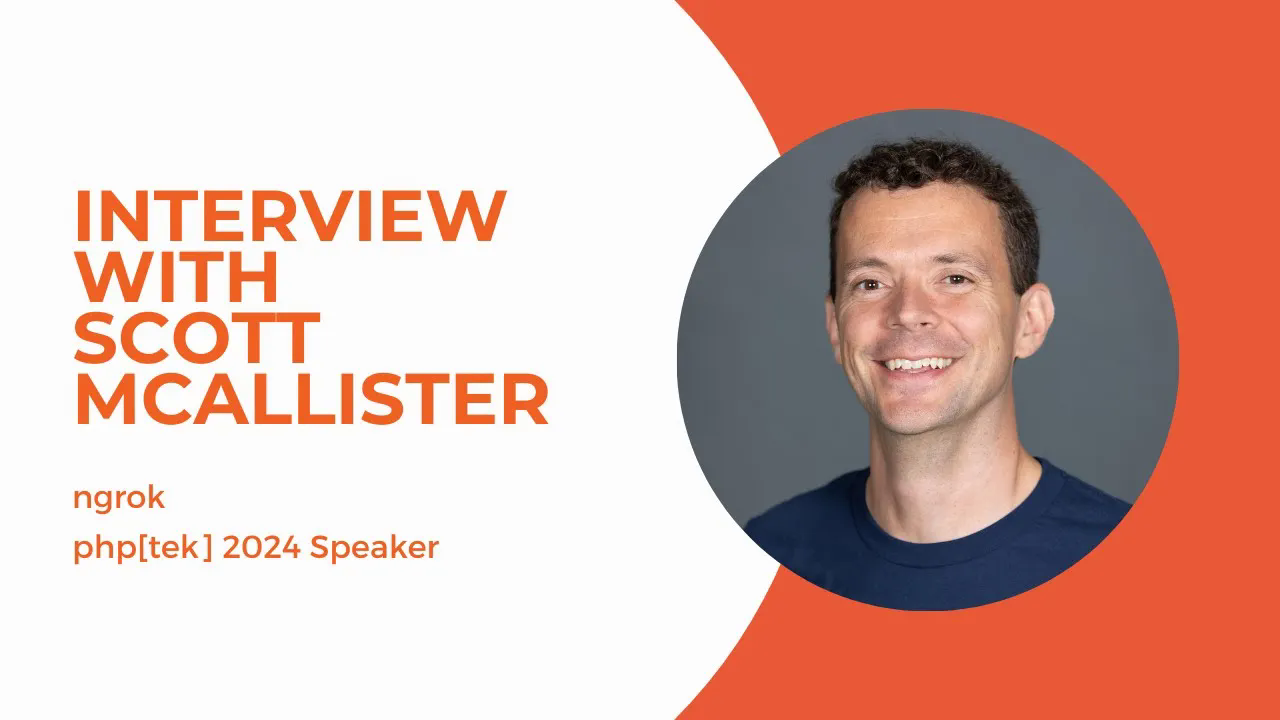
In this video, Scott talks to Scott McAllister from ngrok about some of the features ngrok can provide to its users and Scott's talk about webhooks at php[tek] 2024
Links:
ngrok - https://ngrok.com/
Webhooks.fyi - https://webhooks.fyi/
Tickets to php[tek] 2024 - http://tinyurl.com/tek-2024-tickets
00:00 Intro
00:46 What is ngrok?
01:58 ngrok in production?
03:01 ngrok allows you 1 constant domain
04:19 What is a Principal Developer Advocate?
07:05 php[tek] 2024
07:58 What is your talk at tek?
09:57 What is a webhook?
11:03 Anything else about the talk people should know?
11:24 Outro and plugs
Transcript
 Scott Keck-Warren
0:04
Hello developers, and welcome to the PHP Architect Community Corner, where we have conversations with members of the web development community. I'm your host, Scott Keck Warren, and on today's episode, we're having a conversation with Scott McAllister of ngrok. We're, we're talking about what ngrok is and his talk about webhooks at PHP Tech 2024. Scott McAllister is a principal developer advocate for ngrok. He has been building software in several industries for over a decade, and now he's helping others learn about various web technologies and programming principles. When he's not coding, writing, or speaking, he enjoys long walks with his wife and skipping rocks with his kids. Thank you, Scott, for finding some time to talk to me today. Thanks for having me. This is great to be here. Yeah, absolutely. So you work at ngrok. Can you tell us a little bit about what it is that ngrok does?
B
Speaker B
0:51
Yeah. ngrok, we call it a unified ingress platform. So essentially folks might've heard of us as a developer tool that provides easy access to an app running on your machine. So you're building something on localhost and you want to share it with your team. You can fire up ngrok in your command line and specify the port and it routes traffic to your application. ngrok returns a URL that gives you a, you know, that you can pass around to folks and you can provide easy access to that particular application. That's how we started. We started as a, as a tool for testing out webhooks and we've progressed. We've progressed now to be a more production-level, uh, utility that can be run in any environment, whether it's on your machine, whether it's up in a public cloud, whether it's in a data center, and it can provide that easy, secure, quick access to whatever you need it to, to connect to. So it's, it's super interesting. I knew about it as the developer tool and then as I started here as an employee, it was like, oh wait, we're doing all this other stuff too. And so that's, that's when I decided to jump on board.
Scott Keck-Warren
1:58
Yeah. Awesome. So, so we mostly use it as a, here you have access to my computer to do some testing or to do like webhook development. So can you talk to me a little bit more about it being used in a production environment?
B
Speaker B
2:11
Yeah. So we're starting to embed it inside of SDKs. And so we have a Go SDK, we have a Kubernetes ingress controller. Uh, that way, if you have a cluster that you want to provide ingress to, rather than setting up all the different pieces of ingress saying, you, you know, you set up your, your, uh, reverse proxy and then you set up a load balancer and then you set up other pieces of like authentication. All that can be included inside of ngrok. ngrok will handle all of that stuff for you. You use our load balancers. You don't have to rely on say whatever cloud provider you're using and setting up, you know, dealing with their load balancer, paying for their load balancer. Um, that would be handled through ngrok. And so essentially we're, we're trying to provide a lot more features into ingress. That way you can think about it once and not have to think about all the, each individual pieces.
Scott Keck-Warren
3:01
Hmm. That's really fascinating. I didn't honestly even know that it did that. Like, I know that there was like a pro version that allowed you to, you know, to keep a, like an address, but I didn't know that there were, there were additional features outside of that.
B
Speaker B
3:13
Yeah. And actually, The, they just, they, we, we just, uh, within the last few months, uh, decided to let even the free accounts keep one domain. So you can have one static domain, uh, that you can use for, for testing and things. Uh, so that's kind of handy for when, when people are testing out like OAuth and webhooks, you know, when you want to have a consistent address, you can have at least one, uh, ngrok subdomain.
Scott Keck-Warren
3:37
Yeah, that's really helpful. Cause like we're, we usually like have to set up ngrok and then have to like, we have like all these checklists to like how we set the webhook up. in order to be able to check, like, to make sure everything's working. So that would be really, like, hugely beneficial to just say, well, you just set one and it's all set.
B
Speaker B
3:51
Yeah. Yeah. It's super nice.
Scott Keck-Warren
3:53
So how does it, how does that work for like a pricing model? Like, are, because we're using your load balancers, are we then paying for your bandwidth?
B
Speaker B
3:59
Right. So then it's a pay-as-you-go sort of situation and you would pay for the amount of traffic that's passing through. Um, then you're only paying for what you use and not for what you don't. Um, so in that situation, in a production environment, it changes from a, you you know, a per-license sort of thing to more of a bandwidth sort of pricing model.
Scott Keck-Warren
4:17
That makes sense.
B
Speaker B
4:19
Yeah.
Scott Keck-Warren
4:19
So, you're a principal developer advocate at ngrok. What is it that your day-to-day is?
B
Speaker B
4:24
What I love about being a developer advocate is the fact that there's variety. I get to do things like this where I come on podcasts and talk to folks. I give— I go to conferences and give talks. I can write blog posts. I can build tutorials. I can make videos. I can do some coding. when we need to build samples. And so for me and my ADD brain, it's fun to have multiple things to focus on so I can bounce between the things and still feel like I enjoy what I'm doing. And so it's just a lot of fun. And so essentially what we do in a general sense as a developer advocate is we're trying to create relationships with the developer community and wherever that developer community is. And so if it's, if it's through written content, if it's through conferences in person, if it's through online things or making, you know, short videos on say how to do something, then, then we're there.
Scott Keck-Warren
5:14
That sounds actually like kind of really fun. It's kind of like what we do. Like we do podcasts and we do educational videos and blog posts. So, so that's really like a nice, nice kind of like thing to do as like, as part of the community for sure.
B
Speaker B
5:24
Yeah. Yeah. I love it.
Scott Keck-Warren
5:25
How long have you been doing that?
B
Speaker B
5:27
I've been a developer advocate for, oh, let's see. I've been here a year and I was there for a year, about 6 years, 2017. So yeah, that's 6, 7 years. Um, yeah. I mean, funny story how that got started. I was a software engineer at a company called Smartsheet and we had this guy sitting on the other side of the cube wall that we hired. And, uh, he kept going off to conferences all the time and I was like, Ted, where are you going? And he's like, oh, I go speak at software conferences. And I was like, wait, we pay you to do that? And he's like, yeah, it's called developer relations. That's all. I'm interested. He's like, all right, I'll let you know when I have headcount. And, uh, he, he got me started on that road of knowing what developer relations is and just being a part of that, uh, career path. And I've, I've really enjoyed it ever since.
Scott Keck-Warren
6:14
So there's, that's really cool. So like at Tech, there's a couple of people that have also had that kind of career path, right? They started out as developers, but they wanted to do more conferencey things. So they were like, oh, I'll become a developer relations, developer advocate, whatever, you know, job role that was called at that company. So that really kind of opened those doors for them to do
B
Speaker B
6:33
that. Yeah, yeah. It's a lot of fun if you like interacting with people and you like variety. And honestly, you got to be willing to context switch a lot because you never know what you're going to be doing that day. It's like, I might sit down and think I'm going to be making videos today. And then like, wait, actually, no, I'm going to have a podcast interview or something like that. And so it just— it's a lot of fun. There's a lot of variety.
Scott Keck-Warren
6:53
Yeah, it definitely sounds like a certain, you know, neurodiversity, more or less, would do very well in these kind of— in that kind of a position.
B
Speaker B
7:01
Yeah.
Scott Keck-Warren
7:02
We'll be right back after a word from our sponsors. Attention PHP developers, did you know that one of the best ways to improve your skills is to attend a conference? It's true, and have I ever got a deal for you, because PHP Tech is returning for another year of leadership expertise and networking all in one event. It's a relaxing atmosphere for tech leaders and developers to share, learn, and grow professionally while also providing you with the knowledge to solve your everyday problems. You'll learn Xdebug from its creator and how to write sustainable code. So join us April 23rd to April 25th, 2024, just outside of Chicago, Illinois, or online as all of the talks will be streamed live. If you can't make it during the conference itself, all the talks are gonna be available for you to watch later at your convenience. You'll even get access to last year's talks. Tickets are on sale now at tech.phparch.com or use my link in the description to get a discount. Now back to our video. We're back with Scott McAllister. So you're going to be one of the speakers at Tech this year. Um, would you be willing to talk to us a little bit about what your talk is going to be about without, you know, obviously spending the 50 minutes or so that you would normally spend on it?
B
Speaker B
8:13
Right, right. Uh, I'll be talking about webhook security and, uh, essentially simple ways that you can make it better for you as a as a listener or as a consumer of webhooks, but also as a producer of webhooks. And the bulk majority of my talk is actually gonna be based on a website that houses some research that we've done here at ngrok, actually. It's called webhooks.fyi, and it's where we researched over 100 different providers and cataloged how they did security and how they did— how they are doing webhooks today, so that we can try to find some patterns and set some standards And so, it's a little bit, uh, kind of like going and I wouldn't say preaching, but you know, like trying to preach standards of like, let's do webhooks this way. And so, gonna talk about some of the different ways you can secure webhooks and, uh, so get people thinking about it.
Scott Keck-Warren
9:04
Yeah, that's really fascinating. So, it's like, um, we, at my day job, we're like, I'm very much a consumer of webhooks. Like we have 4 or 5 different like endpoints for different webhooks. And I am always shocked at how some of them are just like, here's some data. And it's, you know, like we just accept it as, as truth. Um, and then some of them, like we have to actually un-sign, you know, like verify the signature on the webhook. Cause like some of them don't even like sign the webhook. They just, they just like send data over and you're like, well, it could be from them. It could be from some rando. So that'll be really interesting to hear all about that.
B
Speaker B
9:37
It's incredible how easy it is to spoof a webhook. So, uh, yeah, yeah, we'll, we'll talk about some ways of, of how to, you know, make sure that it's coming from the right source and as a provider that you're actually sending it to the person who subscribed. Uh, there, there's some, you know, some security measures you can take there to protect yourself as someone who's providing webhooks.
Scott Keck-Warren
9:56
And I guess maybe we don't think we defined a webhook and can you, can you like briefly like define that real quick?
B
Speaker B
10:02
Yeah. So a webhook is essentially, I like to think of it as a subscription, right? Like in, in a regular HTTP model, you send a request to a server, the server sends a response. But in a webhook situation, you actually tell the server, hey, by the way, whenever there's updates, just send updates to me, to this address right here. And so the server or the provider of the webhook will be like, all right, I have this address. Whenever there's an update on this particular object, I fire an HTTP POST back at this listener. And so it's sort of a, it's just a way to keep up with data that changes. updates to various things, maybe like stock prices or sports scores or PR requests on our projects, that type of thing.
Scott Keck-Warren
10:46
We, and we use it, we're like, we're a consumer of Stripe. So like Stripe sends us webhooks and it says like, somebody has paid, somebody has credit card was denied, you know, it's like, so those are, those are the kind of like, it can send events as things occur essentially is the way I like to think about it. If that's helpful for others. Um, is there anything else you want to talk about for in your, in your talk area or?
B
Speaker B
11:08
No, it's gonna be interactive. So folks who want to have something where they're gonna be interacting with the rest of the group, that's the— those are the kind of people that want to come to this talk. You're gonna be helping me create some webhooks, and then we're gonna be testing them out and verifying them and things like that. So it's gonna be a lot of fun.
Scott Keck-Warren
11:24
Yeah, that sounds like a lot of fun. Is there anything else that you want us to tell people about or direct them to for more information about ngrok or any of the other things we talked about?
B
Speaker B
11:34
Yeah. I mean, ngrok.com, you can sign up for an account. They're free. Uh, you can set— sign up for a free level, uh, account there and find information about ngrok and our various offerings. And then also, if you want to do some pre-reading about my talk, webhooks.fyi is, uh, is the source there. And if you provide webhooks and your webhook is not listed in that directory, let us know. Uh, I would love to add you to that list of providers because we want it to be, uh, just an open, collaborative effort to standardize webhooks and webhook security.
Scott Keck-Warren
12:05
Okay. And we'll put that in the show notes and the link for the video for this. So, or the description for the video for this, for everybody who's interested in that.
B
Speaker B
12:13
Cool.
Scott Keck-Warren
12:13
So, I thank you for finding some time to talk to us today.
B
Speaker B
12:17
Thanks, Scott. It was a lot of fun.
Scott Keck-Warren
12:18
I have to say another heartfelt thank you to Scott for his time today, and thank you for listening to our podcast. If you're not already subscribed, make sure you subscribe with whatever your preferred method is, so you can get episodes as soon as they're published. Make sure you share this with your coworkers so they can learn from it as well, and maybe I'll see you at PHP Tech 2024. This podcast is available in both audio versions on the PHP Architect website and a video version on our YouTube channel. This is Scott Keck Warren for the PHP Architect Community Corner, signing off and reminding you to keep listening, keep coding, and keep reading.