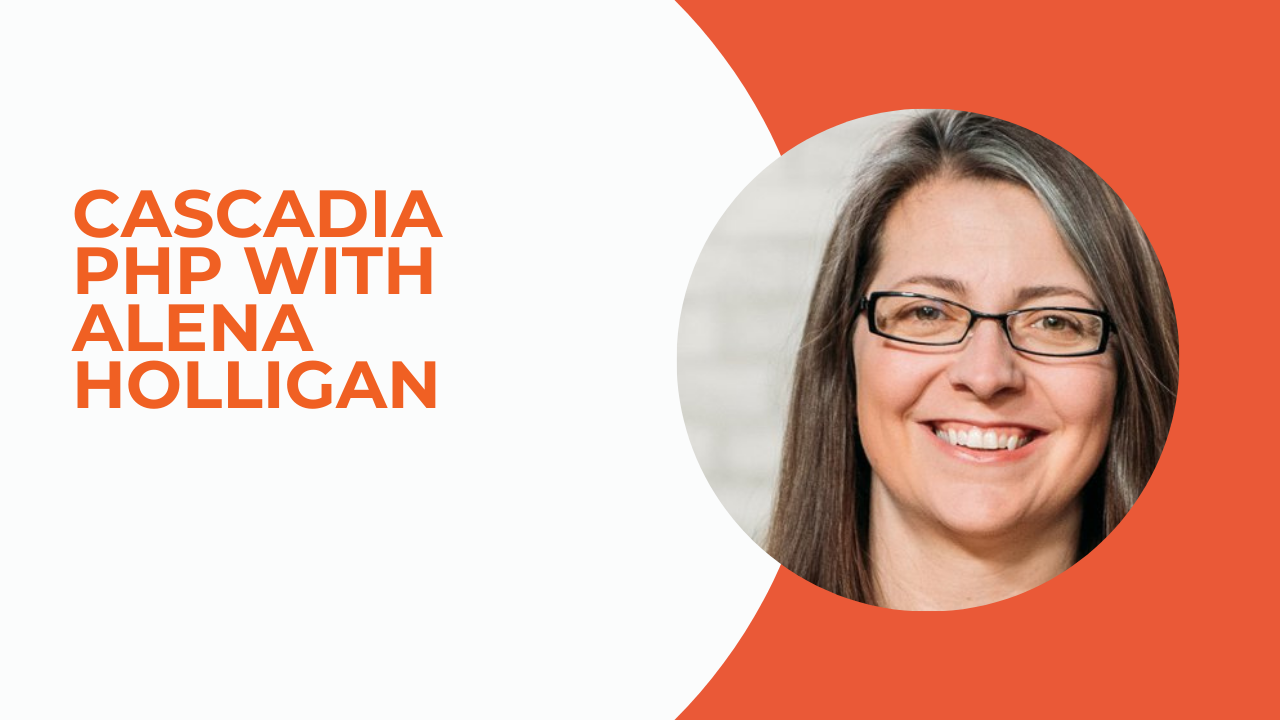
In this episode, Scott talks to Alena Holligan about Cascadia PHP.
Links:
HoneyBadger.io - https://HoneyBadger.io
Cascadia PHP - https://cascadiaphp.com/
00:00 Intro
00:52 What is Cascadia PHP?
10:45 HoneyBadger
11:35 Tutorial Tracks/Access
18:44 What do people need to know about Cascadia PHP?
24:53 Outro
Transcript
 Scott Keck-Warren
0:04
Hello developers, and welcome to the PHP Architect Community Corner where we have conversations with members of the web development community. I'm your host, Scott Keck Warren, and today we're talking with Alaina Halligan about the Cascadia PHP Conference. For over 25 years, Alaina has been building web applications to inform decisions and solve problems across diverse industries. She enjoys both the creativity of programming and the thrill of solving a problem. As a community leader, technical trainer, wife, and mom, she is passionate about providing the tools and mindset required for everyone to learn and succeed. Thank you for finding some time to talk to us today.
 Alena Holligan
0:39
You're welcome. Thanks for having me.
Scott Keck-Warren
0:41
Awesome. So, uh, you are here today because you are one of the organizers of Cascadia PHP. Um, can you tell us like a little bit about the history of Cascadia PHP and, and what it is?
Alena Holligan
0:51
Sure. It's a community conference in the Pacific Northwest. So, it actually kind of took over from CPHP in Seattle. They did for a couple of years, and then the organizers there, you know, life gets moving on and, you know, it doesn't work anymore. So, several of us from the user group in Portland were like, hey, we'd love to see community conference still on this side, on the West Coast. So, let's take it over. And so we took over that conference, changed it up. It was just too hard to keep it the same. Changed it to Cascadia instead of CPHP. We wanted— our goal was maybe it would be— didn't necessarily always have to be in Portland. You know, somewhere in Cascadia area, which is that belt near the coast in Washington, Oregon area. And so we started back 2018. 2018 and 2019. Yeah, I think we did 2 years, 2018, 2019. Of course, 2020 comes around and everything goes— And so we stopped the conference. Hadn't brought it up yet. It's been— Portland's been a little bit lagging in bringing back in-person stuff more than other places, and so it just hadn't been as much of a thing. And then Lara Kahn took over— decided to go to Dallas, I think, this year, Texas area this year, very close to Longhorn. And so the Longhorn organizers are like, hey, maybe we'll skip this year and help you start up the Cascadia PHP Conference again. Because as most of us organizers are not like really strict on like, you have to come to my conference. Like, we just want to make it accessible to people. So it's nice when it's in different areas in the, in the States, you know. It's not like Europe where you can go in 16 different countries within 5 hours, you know. Here it takes, what, 6 hours minimum to like fly across the country. And that's a straight flight. So it's nice when you can have different places to go to and be more of a community conference. So the Longhorn organizers said, hey, we'll help out. And I'm like, okay. I had been considering starting it again, and since it was easier with our— we really liked the University Place Hotel. It's a great partner because they're tied to the university. They're about education as well. The food is fantastic, the people are great to work with, the prices are good. It's really easy to get to because there's a MAX stop, the light rail, right outside the conference. So all in all, fantastic place to have it. All of my contacts were blessedly still there, and so that made that like, okay, well, that's a really huge piece of the puzzle too. And so it's been like, okay, I guess that was the push we needed to try it again. So hopefully that's a good indication that this is going to be a great year that's going to be really influential to a lot of people and really helpful. Because I know for me and several people in the community, conferences have been one of the biggest influencers in their careers because you get to meet people And even if you're not looking for a job now, almost no one keeps a tech job more than, what, 18 months is the average? So the chances that you're going to look for a new job soon are pretty high. And so having contacts in the community is a fantastic way to get your next job or even know where you should be going or get help or get those introductions. It's networking and being able to actually talk to people is just a fantastic thing for your career. You also get to learn what's out there and what things are exciting and new and who they are, and you can make those contacts where you can ask those questions. Like, Google is great, you know, just Google it. That's great. But when you're trying to learn something, oftentimes the terminology around that thing is very inaccessible if you don't understand the basics first. So a conference lets you get that part of it where you can understand what's— what that thing is about, and then you're ready to Google and not be so confused by the answers. I don't know, maybe it's just me, but many times when I've looked something— looked for something, I search and the results I get just like give me more questions. I'm like, that I still don't understand. Now I have 6 more questions. Like, this is not what I needed. Like, it's really easy to want to give up then because you're like, I don't understand this. And so some of my absolute best talks, and those are the speakers that I always looked for, are the people who can get you to understand what this is about and like why and how and where you can go. And then if you run into issues, those speakers love that topic. Like almost all the speakers want to speak about that because they really like it. They like that topic. They like to talk about that topic. So if you want to talk about that topic either at the conference or later, I think most people are probably doing Discord now. So if you want to join Discord and talk to people about that topic, you can reach out to that speaker that you met and you're almost guaranteed to have like an inside scoop on how to use that thing that you're trying to learn. And it's so fantastic in so many ways. So I'm very excited that we can start it back up in Cascadia.
Scott Keck-Warren
7:29
And I'm, I have to say thank you for like, I mean, I, it, from the outside, it seems like a lot of work to like to manage. I feel like you're, you're managing like 50 speakers or something. You know what I mean? Like there's a lot of like herding cats involved in this. And so I feel like that might get lost in the fact that like, this is a ton of work for you organizers who are probably not getting paid for this, right? It's something you're doing as a fun thing on the side. And I put, I guess, fun in air quotes. But, and like, so I have taken, I've been on kind of both sides of like the conference track. I've been both a speaker and an attendee. And as a speaker, I love it when people come up after the talk and they say, hey, I have a question. Like, can you explain this a little bit more? Because like, that's like a really like nice connection that I've made with like that person in particular, but it's also like, oh, I'm teaching people. And then as a conference goer, as an attendee, it's like my favorite thing is just going to a talk that like I have no idea what they're talking about. And like you'll just pick up on so many like weird little nuggets of information. Like I went to a talk at Tech earlier this year and it was actually, it was one of the talks at Cascadia, right? Tim's talking about Docker for not just deployment stuff. And, and like, that just like completely gave me like a total mind shift as to like how I could use Docker better. And like, I just was like, I want to go see Tim speak. And then now I'm just like, oh, okay. This just like totally changed my, like how I, how I build Node stuff on my computer. Cause I don't need to install it anymore.
Alena Holligan
9:02
Right. Right. I was, one of my, one of my favorite talks that I'm super excited about this year because it was, uh, Years and years ago, one of the best talks I ever went to was Brett's talk on regular expressions that totally changed the way I thought about them. Now I can't always write a regular expression right off the top of my head great. There are tools that help you with that, but the concepts are there now. Like, I understand it. I use regular expressions all the time. They're language agnostic. They're program agnostic. Like, you can use it in Word. Like, it's— they're so useful for so many things. And his talk is really what got me into using regular expressions and excited about it and like feeling empowered that I could. Like, oh, I can go now and figure out exactly what that syntax is to do the thing I want. But now I have that— my mind's like, oh, I get that. Like, that makes sense now. Like, that's fantastic. So I— he's actually, he's actually in the Pacific Northwest now. And so I'm like, hey, would you like to come do this talk? He's like, oh, it's been a while, but sure, I'd love to. So I'm very excited that he will be there for that because that is great.
Scott Keck-Warren
10:18
Yeah, I— regular expressions is one of those things where it's just like you learn it and it unlocks like a total new world. And especially since you can do it everywhere, like I've used it to solve Wordles before where I'm just like, I'm stuck on this word. What are, what are some options that I have to You know, yeah, yeah. And so that's, yeah, that's like another, that sounds like another, I just like keep going. Like, I want to go to that one, that one, that one, that one, that one. And I'm just, I don't have enough time. So we'll be right back after this word from our sponsors. Do you want higher clarity in production, but don't have the time to earn your degree in observability? Me too. Forget logs, metrics, and traces. Honeybadger Insights is built around structured events. When you send your application logs and other events to Honeybadger, you'll unlock the power of Honeybadger's powerful new querying language, BadgerQL. You can then use BadgerQL to ask any question about your data, convert any event into a metric, and chart your metrics on a custom dashboard. You can do all of this on Honeybadger's free plan as part of their comprehensive monitoring suite, which includes error tracking, uptime monitoring, status pages, and more. Speaking of error tracking, did you know that an error is really just a first-class event in Honeybadger? In fact, you can use Insights and BadgerQL to explore all of your existing Honeybadger data in new ways. It's pretty cool. Give it a try today at honeybadger.io. That's honeybadger.io. And we're back with Alaina Halligan and we're talking about Cascadia PHP. So, so one of the interesting things about the schedule this year is that instead of having an afternoon or a day for tutorials, you're going to have a track every day for tutorials. Can you, can you talk to us a little bit about that and how that came about?
Alena Holligan
11:52
Sure. So one of the things that we've always tried at Cascadia is how do we make things as accessible as possible for people? So we've tried to have childcare available. We've tried to have— one of the hard things for a lot of people with a conference is just, even if you like people, even if you're maybe an extrovert, that many people for that long can be really hard. So being able to stream it back in your hotel room sometimes— that's one of the reasons I like to have it at a hotel, because it's really easy to go back to your hotel to get some downtime away from people. But sometimes you're like, I'd really like to see this talk. You can stream it from your hotel room, and then you can still go talk to that speaker later. Like, don't let that stop you from, hey, I wasn't in that talk, and I'd still like to ask some questions about this. Or even if you're like, oh, there are these 2 talks, I can't go to both of them at the same time. Great, go to one, go talk to the speaker another time. I, I can't overemphasize enough how important it is that you— if you are interested in that topic, so is that speaker. You already have a connection. Go make that connection. So with those accessibility things, we've, uh, we tried to do— we did, uh, closed captioning before there was all this auto-generated stuff. I actually got my dad to come and do that because he's really fast at typing. So he actually typed out all of the main room, uh, closed captioning for us. It was fantastic because there was not— back in 2018, That the auto-captioning, like in real time, was not up to doing, especially when you talked about technical stuff. Like if you were just talking regularly at that time, it could keep up pretty well. But if you threw in some technical jargon, it— So there— so that, you know, different things like that that we've tried to do to make it more accessible for everyone. And one of the things that is sometimes hard for people is maybe you have a— you're working for a company, you can't get off to go to the conference, so the only day you can go is on the Saturday. Or maybe you can't make it on Saturday. That's, you know, you are gone with the commute, you're gone all day, you never see your family. That's the only family time you have. In the whole week, or you already have commitments on the weekend. Work can get— you can get work off during the week, but you can't get rid of your commitments on the weekend. All kinds of reasons. And so we try to make it so that, you know, whatever works for you. That's why one of the options we have with tickets this year is, you know, obviously it's better, it's easier for the conference and less expensive to add additional days. So that's— we pass that savings on to you. So your first day is going to be the most expensive day, but if you add on the next days, it's not going to be as expensive because that's where our costs are too. Like, we don't make money on this. This is for the community. We just want to make it happen. So this year I thought, well, not everybody can make a one full day of tutorials. Maybe Thursday is not the day you can come or whatever that We have traditionally at PHP conferences had like one day of tutorials or maybe the afternoon. So this year I'm like, well, you know, let's change it up. Maybe, I don't know if it'll work or not, but it's worth a try. Maybe it would be helpful to have that throughout and some people can get the opportunity to go, oh, that tutorial was much more helpful for me. When people talk, I just can't process it as well that quickly. And then there's so much going on, it's really hard for me to do a talk and really learn everything. But if I go to a tutorial for 3 hours and I actually have my machine and I can do stuff, and it is more of a hands-on, actually doing things, that's much easier for me to learn. And so maybe you've— maybe it's the first time at a conference and you want to be able to try that kind of format out and see what works for you. So we're— I'm really excited that we can have that available this year at the conference. Hopefully it'll be a good thing. If it doesn't work for people, you know, we can always change it again another year, but it's something we're experimenting with.
Scott Keck-Warren
16:39
I, I think it's really like an interesting concept, especially since sometimes, um, the, the trouble you run into is like all the, all the tutorials are running at the same time and you might go to one tutorial and then be like 30 minutes into it and be like, this isn't working for me. Or it's like not what I thought it was going to be. And then, then you're kind of stuck. Like you can't like jump to the other tutorial, but this is nice cuz they'll be like, this isn't for me. I'm gonna go over and look at like a different talk or something.
Alena Holligan
17:04
So I mean, thanks for bringing that up because that's another thing that, um, for people who may not be comfortable at a con— uh, at a conference or like don't want to offend the speaker, like as a speaker and most speaker, I've, I'm a speaker myself. I know a lot of speakers that I've talked to. Most of us are not offended if you came to this talk and it's not what you expected and you'd rather go try something else. Because maybe most of the time you're like, ooh, do I want to go here or there? Well, let's try this one. And then you go and you're like, oh, this is not what I expected it to be for whatever reason. And that's fine. Feel free to get up and go to another talk. That's absolutely fine. We're not We're not offended by that. We would rather have somebody get out something that they needed from the talk instead of someone sitting there being lost the whole time.
Scott Keck-Warren
17:59
I don't want to speak for the other speakers, but, um, for me, I'd rather have somebody like leave early than to like sit there and just be like checked out. Like, because you can tell, you can tell when people are just sitting there, they're just completely checked out.
Alena Holligan
18:13
Right. Because they're like, I'm lost. I'm lost. I, this isn't what I wanted. So now I'm. disappointed in being here. So now my brain isn't even working right to get what I could have maybe gotten out of if I was prepped for it. So yeah, almost everybody I— any— almost all the speakers that I know are very much on board with that. If it's not working for you, try something else.
Scott Keck-Warren
18:40
Is there anything else that you want to direct our listeners to before we say goodbye today?
Alena Holligan
18:43
CascadiaPHP.com is the website, so you can link to things there. The schedule's up now. It was a challenge to get up this year, but I'm really excited about the way it turned out. So that should give you a good idea of what's gonna work for you. And then from there, you can also link to the registration. Like I said, we have the 3 options. Your best deal, of course, is gonna be there all 3 days. That's the best price for us as a conference to have everybody there and just be able to schedule that out. So that's of course the best price you can get. Uh, they— we have early bird tickets now through, uh, the 8th, I think I have it going. We should— we usually have to submit, uh, final numbers for conf— for the, uh, food like 2 weeks before. So that's the— that's kind of the important date at this point for people. So the conference is October 24th through the 26th, so Thursday, Friday, Saturday. And so we're trying to get tickets in 2 weeks before so we have numbers and we can— that we can give. Now, that's not to say if you didn't get the early bird tickets, that's why we still have sales. It's okay if, you know, you were working with your— you're not sure if you're going to be able to get off or what. Your work said yes, but it takes a long time to get the approvals through to purchase the tickets and all that. That's perfectly okay to do that last minute. Still, we still want to have you, but we would like the majority of things in before I have to give final numbers. Because if my numbers are way off, if I, you know, average, oh, I expect that we're going to have 50 more people in the last 2 weeks and we only get 5 more people, like, that's really gonna affect our numbers there. And so food costs actually are huge for the conference, and so being able to have a good number about that. So that's important. That's what's important at this point is if you can try to get your ticket in, if that's possible, do it. If not, still please come. We still want you to come. We do figure out having a few more people sign up last minute. So that is perfectly fine if you are one of those people.
Scott Keck-Warren
21:08
Awesome. And, and so right now, there, there's no ticket for streaming only. But is that something that might, might open up at some point?
Alena Holligan
21:16
There it is. I would still encourage everybody to come if you can make it. We, we do try to have streaming for several reasons. Again, like I said, accessibility is important. I like to have streaming just so you can stream it to your hotel room even. We do have some great people that are hopefully going to be doing the streaming for us and have lots of experience with that. And we've done streaming before at the conference, so I don't foresee it being a problem. But depending on how confident those volunteers are with the ability will depend on if we actually open up streaming last minute. So if that is all that you can do Please watch for that. And if we can make it happen, we will.
Scott Keck-Warren
21:58
OK. And that sounds like a great option. If it comes available, it's a great option. But I do have to stress, it's way better going to the conference than it is staying at home and watching it online because you're not going to get the same impact because you're just going to be completely distracted.
Alena Holligan
22:13
Yes. I mean, you can watch— you can go to YouTube now. There's lots of stuff out there. There's lots of past conferences that you can watch out there. That is a great tool. Please use it as a tool. Go watch some conferences that are out there now, oh, that already have those talks uploaded to YouTube afterwards. They're ready to go. You can watch something specific. You can still— let me still encourage you— you can still watch that talk and go into Discord and chat with that speaker. That's still a possibility. You chat with them afterwards, meet them, but it's not the same as having that personal connection where, hey, I went to your talk, I went up to you and met you afterwards, and now I'm reaching out to ask you a question about it. That's a lot more of a personal connection there. You're not going to have the networking to support your career that you would have at the conference. We've got another one we've got going. Another talk I'm excited about this year is help with resumes because that's been a big thing. I know a lot of people that are like, hey, I've been in the tech industry for 15 years and I've never really had to worry about my resume before. It was just easy to get a job, and now I'm finding that it's not as easy to get a job, especially because a lot of companies have gone to automated scans of your resume. So a person may not even look at your resume because it might not get through that first AI bot that's saying, hey, is this a person we want or not? So thinking about your resume can be a lot more important now. So I actually have— someone local that does a lot of resumes and other stuff to promote yourself, and they're going to come and do a talk for us about resumes. And then I am sure they'll be there to help. We actually have that scheduled right before lunch, so you have lunchtime to work through some stuff and talk to people. We'll have a few— we'll have other people there. We'll probably try to get something Um, where you can get feedback on your resume. Well, if you're interested, or people who have— I know a few people, a few of our speakers who have been or are hiring managers that would be happy to give you some feedback on your resume. So that's an added bonus coming to the conference. You would get some of that that you're not going to get online. So that's another thing that I'm very excited about, and I'm hoping that Will be very helpful for people.
Scott Keck-Warren
24:47
Yeah. Sounds great. Thank you again for, for finding some time to talk to us today.
Alena Holligan
24:50
You're welcome. Thanks for having me.
Scott Keck-Warren
24:52
I have to say another heartfelt thank you to Alaina for her time today and for yours as well for listening. If you're not already a subscriber, make sure you subscribe with whatever your preferred method is so you can get the episodes as soon as they're released and maybe share this with a coworker so they can learn about the conference as well. This podcast is available both in an audio version at the PHP Architect website and as a video version on our YouTube channel. This is Scott Keck Warren for the PHP Architect Community Corner signing off and reminding you to keep listening, keep coding, and keep reading.