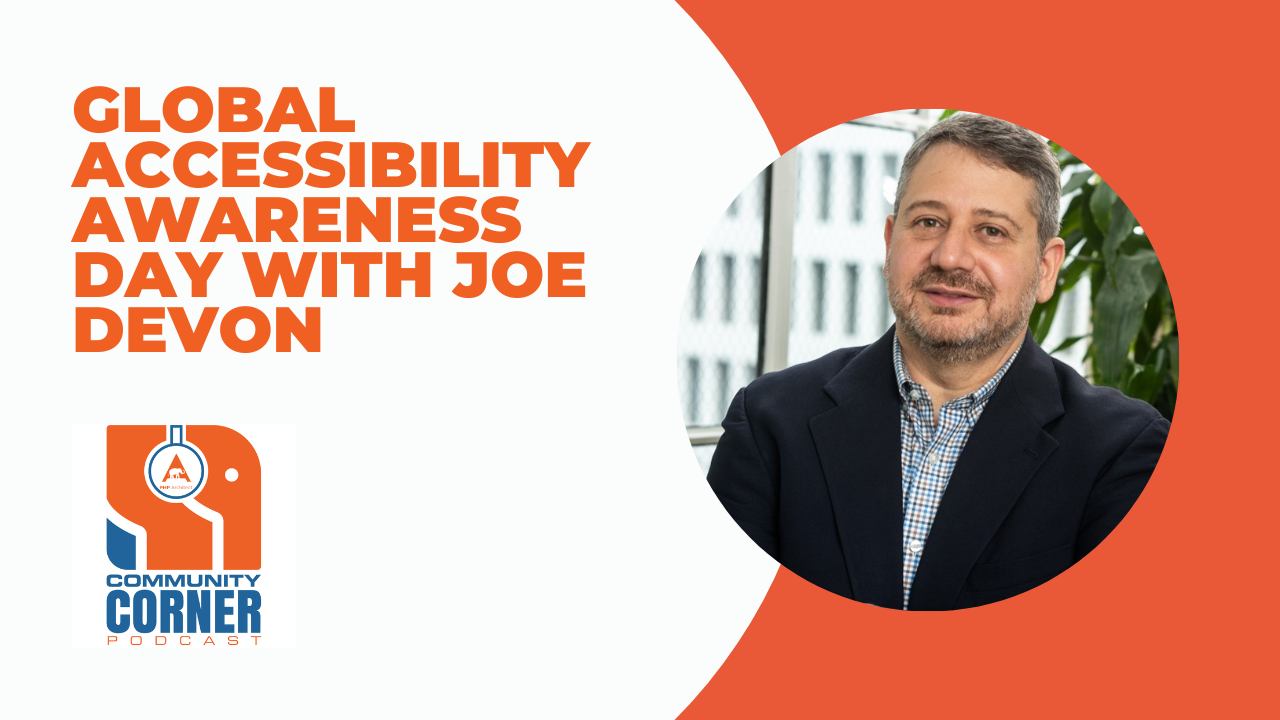
In this episode, Scott talks Global Accessibility Awareness Day with Joe Devon the creator of the day.
Links:
- Our Discord - https://discord.gg/aMTxunVx
- Buy our shirts - https://store.phparch.com/products/community-corner-podcast-t-shirt
Joe's Links:
- LinkedIn - https://www.linkedin.com/in/joedevon/
- Global Accessibility Awareness Day - https://accessibility.day/
- Accessibility and Gen AI Podcast - https://podcasts.apple.com/us/podcast/accessibility-and-gen-ai-podcast/id1759047581
Scott's Links:
- Website - https://scott.keck-warren.com/
- Bluesky - https://bsky.app/profile/scottkeckwarren.bsky.social
- LinkedIn - https://www.linkedin.com/in/scott-keck-warren-91689810/
- Mastodon - https://phpc.social/@scottkeckwarren
PHP Architect Social Media:
- X: https://x.com/phparch
- Mastodon: https://phparch.social/@phparch
- Bluesky: https://bsky.app/profile/phparch.com
- Discord: https://discord.phparch.com
Subscribe to our magazine: https://www.phparch.com/subscribe/
Partners
This podcast is made a little better thanks to our partners.
Displace
Infrastructure Management, Simplified Automate Kubernetes deployments across any cloud provider or bare metal with a single command. Deploy, manage, and scale your infrastructure with ease. https://displace.tech/
PHPScore
Put Your Technical Debt on Autopay with PHPScore https://phpscore.com/
CodeRabit
CodeRabbit - Cut code review time & bugs in half instantly with CodeRabbit. https://www.coderabbit.ai/
Music Provided by Epidemic Sound https://www.epidemicsound.com/
phpc #php #communityCornerPodcast #podcast #phptek
Transcript
 Scott Keck-Warren
0:05
Scott Keck-Warren
0:05
Hello developers, and welcome to the PHP Architect Community Corner podcast, where we have conversations with members of the web development community. I'm your host, Scott Cackhorn. Today we're talking with Joe Devon about the Global Accessibility Awareness Day. Joe Devon chairs the GAAD Foundation, where he leads initiatives to embed accessibility as a core requirement in technology development. In 2025, he launched the AI Model Accessibility Checker under the foundation's Aspas, Aspas with ServiceNow, creating the industry's first benchmark for evaluating how AI models generate accessible code. Throughout his Gen AI podcast and advisory work with major tech companies, Joe shapes how organizations integrate inclusive designs into their AI strategies. Joe brings unique technical and business perspectives from building everything from high-traffic systems like AmericanIdol.com's backend voting platforms. To running a 100-person consultancy, to developing the AI-MAC entirely through agentic coding. Having served as a web developer, CTO, CEO, and AI strategist across Fortune 500 companies and startups, he understands both the engineering challenges and organizational transform required for accessible innovation. He co-founded Global Accessibility Awareness Day in 2012, now an annual worldwide event promoting digital inclusion for 1.3 billion people with disabilities. Check out the podcast at youtube.com/a11ygenai, and we'll put a link to that in the description so you don't have to type that all out. But thank you, Joe, so much for finding some time to talk to us today.
B
Speaker B
1:38
Absolutely. My pleasure.
Scott Keck-Warren
1:40
Yeah. So that's quite a resume that you have going on. Um, I feel kind of bad asking you such a simple question, but, um, can you explain to us what accessibility is and why it's important for developers?
B
Speaker B
1:52
Yeah, accessibility is developing technology, digital products that work for people with disabilities. It's, I guess, become cliché at this point to mention, but it's the task that I think people are able to understand very quickly is using screen readers. So that's where if you're blind, you cannot see a mouse pointer. You can use the keyboard, but you can't use the mouse. And so You also cannot read the screen, so you have a screen reader that just speaks the words on the screen, and you control it with your keyboard. And if you do all kinds of funky stuff, like try and redo the scroll bar, which JavaScript has redone everything from time to time, that makes it inaccessible and makes things not work with a screen reader. Also, A lot of the frameworks have replaced semantic HTML. There's a lot of web developers that don't know semantic HTML, which is unfortunate. And semantic HTML builds in all kinds of features for free, including accessibility. So if you don't pay attention to it, you're not aware of it, you're going to lock out people with disabilities.
Scott Keck-Warren
3:12
Yeah, I think so. I think, like, can we talk a little bit about like the semantic HTML parties? Because I know like that's an important part of this and I don't think it's covered. Like most people don't know what it is, right? And so can you kind of explain what that is a little bit?
B
Speaker B
3:24
Yeah. So you have, you have like different parts of your, different parts of the screen when you're surfing a website. So you have main and you have nav, you have different elements. And if you don't— what's happened with a lot of frameworks is they replace it with divs. So you can have, let's say, a button, but instead of using the word button, you have an image and then you don't specify the role as button, then the screen reader doesn't understand what that image is. And ideally, if you just use the actual like form tag, the button tag, all of the different tags, then it's semantic. And by being semantic, the screen reader and other assistive technology understands it.
Scott Keck-Warren
4:22
Yeah. And I always find it interesting because, and I've had like push and pull with this, with like other developers essentially is like, 'cause a lot of frameworks are just CSS frameworks in particular, just like everything's a div. Just put everything in a div and you're all fine. And then I'm just like, yeah, but nobody can use this. And it's just, it's just like completely unusable for people who have screen readers or have vision disabilities or vision issues, um, or, or something similar to that. So it is like a very important piece. I think like anybody who's not aware of it and not using it is, you know, they're just waiting, waiting for a problem essentially. Yeah.
B
Speaker B
4:56
Yeah.
Scott Keck-Warren
4:56
Yeah.
B
Speaker B
4:56
Um, and it's a shame. There's no need for it. That doesn't really help. All it does is remove what's been built into the web and the standards.
Scott Keck-Warren
5:06
Yeah. And I always like find it interesting too, cuz like sometimes, you know, like people will make it, it, they'll take like a select box, right? The select box is my favorite example cuz everybody tries to override that and you'll end up with like some weird thing and like it might not work on my smartphone. Right. And I, like, there was a website for a local organization and they had done that and I couldn't, I couldn't buy a ticket on my phone because they had like redone the select box and it didn't work on, on mobile devices, which was shocking to me.
B
Speaker B
5:34
Yeah.
Scott Keck-Warren
5:35
But they— I messaged them, I said, hey, this doesn't work on my phone. And they're like, oh yeah, we'll fix that. And they just went right back to the default select box. It was really like kind of hilarious that they probably spent meeting after meeting trying to come up with like a good weird thing for that. And then they were just like, we'll just do a select box.
B
Speaker B
5:50
So yeah, it's unfortunate. A lot of people like want to put craft into what they do and they, you know, everybody— a lot of people are upset by constraints and very often designers love to do something original. But the constraint is actually important because it makes a difference for the user experience for a lot of people that you're never going to have the money to test for. Right, right.
Scott Keck-Warren
6:15
And I'm a— so one of the reasons that like I'm a big fan of accessibility things is because— so it's one of the, I don't know, sayings that I hear a lot is like everybody's just temporarily abled. And at some point you're going to have some sort of an issue that's going to make accessing a device difficult. And like, I know this from experience because like we had, we've had children, we've had small children, and you have to get used to holding a baby and using your device at the same time. And so I was, I always try to like include that into any kind of conversation about accessibility. It's not that like, just because now you don't have a problem doesn't mean in the future you won't, right? Like everyone at some point is going to have some sort of a technology disability or whatever to make it hard to access things.
B
Speaker B
6:59
Yeah, exactly right. Yeah.
Scott Keck-Warren
7:02
So, and so one of the reasons that you're kind of like on my radar is, is you're part of the Global Accessibility Awareness Day. Can you kind of explain to us what that is and how it came to be?
B
Speaker B
7:12
Yeah. Back in 2011, my dad was in his mid-80s and was just an incredible man who spoke 11 languages. He went through the concentration camps and just commanded respect when he walked in a room. I don't even know how to explain it to you, but I worshiped my dad. And at a certain point, he had gotten phished by a bank. It took him a day to get to the bank because he had to use something in California called Access Paratransit, which meant you had to say it in advance in a day. You could wait for 2 hours. So it was very difficult to do banking. And And, you know, I'd been doing work for American Idol at the time. We had a blind contestant, and I was always wondering, did we do a good enough job in order, you know, for him to be able to access the website? And then my dad just couldn't bank because they changed the colors, and the color contrast made it impossible for my dad to see the screen. And I thought, ah, you know, if you can't bank, You can't be independent. There's no reason that somebody like my dad should be unable to access their bank. So I got upset, but I had always kind of in the back of my mind, because I'd always been on the bleeding edge of tech, and I had barely heard of screen readers at the time. So I thought if I was unaware of it, most people weren't either. So I just, I had a blog called mysqletalk.com. which had maybe 10 people that ever looked at it, and I wrote a blog post proposing a day of awareness, Global Accessibility Awareness Day, which is now known as GAAD for short, and wrote a blog post proposing this day, and to my utter shock, in the very first year, we had such an uptake of this that it was covered in a bunch of media, it was syndicated all through Canada, my hometown, Montreal. We were in 16 cities across the world. India did a governmental event and it's just like from the beginning, it was like, oh my God. And then by the second year, I'd say a lot of it happened on old Twitter. We started to hit like tweet a minute on the hashtag. We started to track how many people were talking about this and We stopped counting when we hit 220 million people. We're like, all right, this is country-level engagement. And this, I mean, I could go on and on with the events that happened, but I would say the culmination was in 2024, the Biden White House did an event and called me up with like 2 weeks' notice. Would you come out and speak about the importance of accessibility? So that's a bit of a history on the event, but the more important thing Because it doesn't matter how much media attention you get. What matters is, is this reaching the audience it's intended for, which is builders, people that are creating technology, and are they aware of the issues with building incorrectly? And that's who we really wanted to reach out to. And I think we've done pretty well in that respect because any company that has an accessibility team tends to do something on that event and uses it in order to educate their employees internally, like their developers, designers, and project managers. Yeah.
Scott Keck-Warren
10:52
And that's—
B
Speaker B
10:52
Makes sense?
Scott Keck-Warren
10:54
Oh yeah, totally. And that's like an amazing, um, like I think everyone wishes that they could write a blog post and have that kind of like uptake on things. It's like, I have an idea and everybody's like, yep, we should definitely do this thing. So that's really, really amazing. And we'll be back after this word from our partners. As a programmer, you know that code reviews are critical, but are also time-consuming. CodeRabbit acts as your AI copilot, providing instant code review comments and potential impacts of every pull request. Beyond just flagging issues, CodeRabbit provides one-click fix solutions and lets you define custom code quality rules using AST grep patterns, catching subtle issues that traditional static analysis tools might miss. CodeRabbit reviews 1 million pull requests every week across 3 million repositories and is used by 100,000 open source projects. CodeRabbit is free for all open source project repos. Get started today at phpa.me/coderabbit. That's phpa.me/coderabbit. And we're back talking to Joe Devin. So like, how is it that like people can, and I'm going to put celebrate in air quotes, how is it that people can kind of celebrate like Like, so for me as just like a team lead, how was it? How can I, you know, like do Global A11y Day? Like, what is it? What is the— what is that? What is it? What should I do as just like a normal person? I think.
B
Speaker B
12:16
Okay. So I would say if you're involved in a company, you know, what we typically will say is try and surf the web without a mouse. Take a look at the accessibility of if you have your personal site or your company site, Bring attention to it internally at your company, write a blog post about it, mention it to a journalist. Really, in the original blog post, the entire— I hate everything I write an hour later. This is the only thing I came back to it after years that actually was well-written and really lays out the playbook of getting the awareness out there. And I would say if you just Google like MySQL Talk Gad or something like that, or my name and Gad, you'll, you'll, that will pop up for you.
Scott Keck-Warren
13:05
But put that in the description, I should say too. We'll put it in the description so people can quickly get to it.
B
Speaker B
13:10
Yeah, great. I hope it's still up there. There's some craziness with, with the WordPress stuff. So I don't think I can even get into the, to the admin anymore. But anyway, for now, yeah, some weird, weird stuff happened. But And then there's also the foundation's website. We started about 5 years ago, gaad.foundation, G-A-A-D dot foundation, and then accessibility.day. And I don't know if you want me to spell that out because accessibility is a mouthful.
Scott Keck-Warren
13:39
Yeah, I'll try to find that as well and put it in the description as well for everybody because it is, yes, it is quite a mouthful.
B
Speaker B
13:45
Yep. Yeah.
Scott Keck-Warren
13:48
But so is there like, so is there some way that like we we as developers can help the foundation? Like, do you all need money or anything like that? Or is this— are you set on that and you need us in other ways to help you?
B
Speaker B
14:00
I mean, we're a pretty scrappy organization. Most of us take no salary, so we're able to operate really lean. So we're doing okay. Money never hurts, and you can definitely find a donation link on there. But at the end of the day, you know, the mission is the most important thing for us, which is to really get the word out about making accessibility a core value in software development. So if you're doing software development, what would help us the most— and it's not about helping us, it's more about helping the community and building more accessible products— is to make that a value in your organization. That's what we care about more than anything else.
Scott Keck-Warren
14:47
Yeah, we gotta help. We have to help your dad and my dad, right? Like our dads need, need the help. Yeah. Um, and our moms. I mean, I'm not being— Sure.
B
Speaker B
14:56
Of course.
Scott Keck-Warren
14:56
Yeah. Um, and, and so I'm, I'm a big fan of this. Like it's always like a good thing for, for us to think about as developers. Um, and I try to, you know, management isn't always like, oh yeah, we should be spending extra money doing these things. So we always just try to like do it without telling them. Um, it's not always great, but we just kind of do it. Like we've just like as a team said, okay, well this is an important piece, and we're just going to add this as part of our testing structure. It doesn't like—
B
Speaker B
15:22
Yeah, that brings up a great point. And what I like to tell people is, you know, the laws go up and down, things change, culture changes, but culture is the center of all of this. And if you're a designer and you're designing, for example, a chat app where you need an online/offline indicator and you use red for offline and green for online, you should know as part of your craft, you should know that folks that are colorblind, the most common form of colorblindness, they both look gray and gray. And you need to just include some textual information, not to use color alone to convey that information. And I love that example because if you have a culture that says, oh, you're a designer and you didn't know this, right? Then it doesn't matter if the CFO has money for this or not. It won't even reach their radar because you're sitting there and you're going to put that word online, offline next to that image, right? And it didn't cost a penny. And in fact, you saved money for the organization and made a more usable product because culturally, you know, you cared about your craft enough to understand that not doing accessibility right is technical debt, right? And now all of a sudden, okay, we've brought it into the culture. So you are 100% aligned with, you know, our mission, which is changing the culture of digital product development.
Scott Keck-Warren
16:53
Yeah. And that red-green colorblind is always my favorite example, because I used to work with somebody who was red-green colorblind, and we literally did not, use some software because he couldn't tell. Like there was, there was like some indicator that was red and green and he's like, I can't tell the difference between those 2 things, so I can't use this software. And we're like, oh, we're out. We're not going to use this. We're not going to give them our money because we can't, we have somebody on our team that can't use it. So unfortunately I do have to draw this conversation to a close. Is there anything that you want to direct our listeners to today?
B
Speaker B
17:22
No, just to the foundation website. If you want to reach out to me on any platform I'm on, I'm @JoeDevon, J-O-E-D-E-V-O-N. Um, and, uh, we have Global Accessibility Awareness Day coming up, so, uh, please check out the GAAD hashtag, G-A-A-D, and, uh, we'll catch you online.
Scott Keck-Warren
17:42
Yeah, I had to say another heartfelt thank you to Joe for all of his time, as well as for yours for listening. If you're not already a subscriber, make sure you subscribe with whatever your preferred method is, and maybe share this post with a coworker so they can learn about GAAD as well. This, this podcast is available within an audio version on our website, as well as a video version on our YouTube channel. This is Scott Keck Warren for the PHP Architect Community Corner signing off and reminding you to keep listening, keep coding, and keep reading.