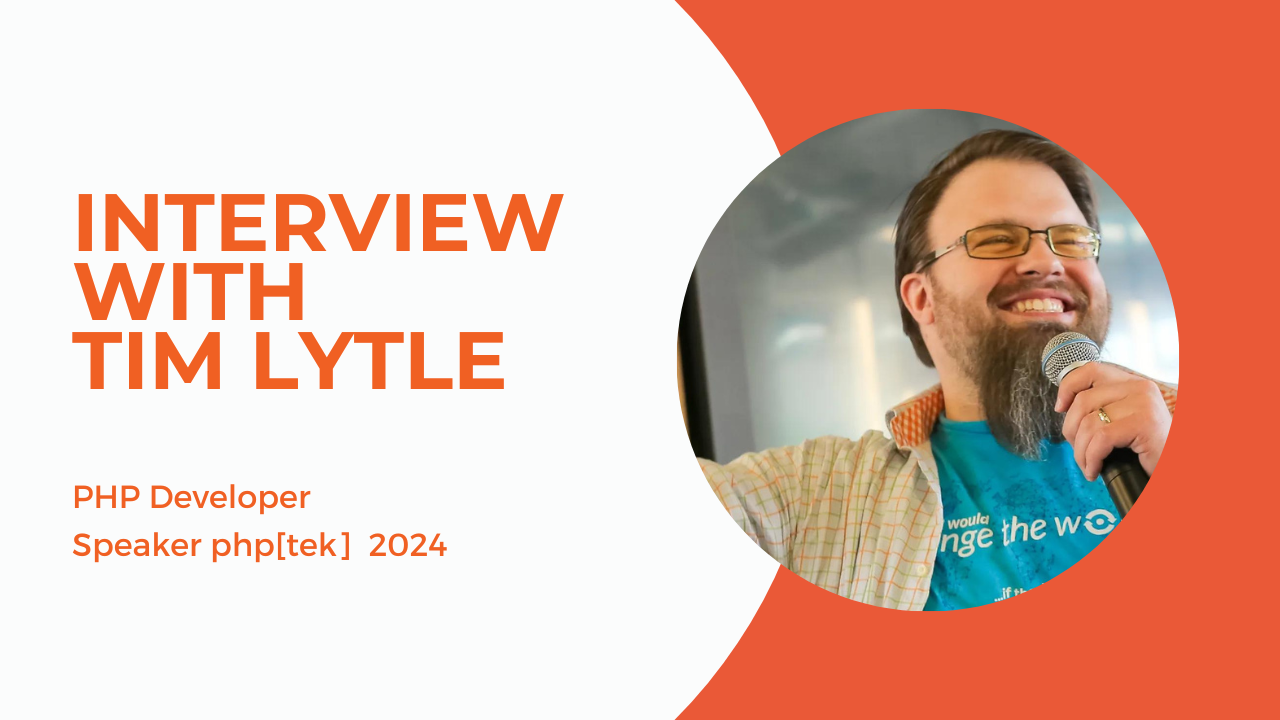
In this video, Scott talks to Tim Lytle about tips for new conference attendees and his talk on Docker at php[tek] 2024.
Links:
Dev Friday Show - https://devfridayshow.com/
Tickets to php[tek] 2024 - http://tinyurl.com/tek-2024-tickets
00:00 Intro
00:36 What was first time at tek like?
05:08 How to help at the conference
09:14 Just talk to people
11:40 php[tek] 2024
12:37 Yak Free Docker
17:45 Dev Friday Show
18:24 Outro
Transcript
 Scott Keck-Warren
0:04
Hello developers and welcome to the PHP Community Corner podcast. I'm your host, Scott Keck Warren. On today's episode, we're talking to Tim Lytle about tips for going to PHP Tech this year and his talk about Docker. Tim Lytle is a longtime mercenary PHP developer who is a fan of Lammas, Doctrine, test-driven development, and practical design patterns. He is a former developer evangelist, coach for the dev team at PhoneBurner, tweets sporadically at PJ Lyle, and hangs out with his wife and kids. Thanks, Tim, for finding some time to talk with us today.
B
Speaker B
0:34
Yeah, sure.
Scott Keck-Warren
0:35
So I know you're a long-term conference-goer, especially at Tech. Can you talk to us a little bit about what your first time at Tech was like?
B
Speaker B
0:43
Sure, sure. Yeah, man, I think it was— I want to say it was Tech 2012, I think. And it was— I mean, it was interesting for me because the way I got to Tech was by becoming a developer evangelist because if you're a developer evangelist, you get to go to conferences. So, I showed up, we had a booth, and I kind of remember, you know, you go to this hotel, especially the hotel in Chicago. It's got all the big rooms, the big atrium, and I don't know anybody there. I've never really been to Tech before. I think the one person I knew, I think at that point, was Keith Casey and maybe some of the team that actually bought Tech. later, but the group that was in DC, because I had gone to a smaller— it was back when they were doing what they call the road show, I think. I forget what they called the conference, but they would go to different cities. So, I met some people in the community there. I get to this big hotel, don't know anybody. I just remember kind of like sitting in my room the night before going, I don't know what I'm going to do here. So, it was an interesting experience. Um, the one thing I can say though is the PHP community is awfully friendly, awfully welcoming. And, uh, you know, it makes it easy to become a part of.
Scott Keck-Warren
1:59
Absolutely. I, I am just like, I've recently started going to conferences. Um, I went to Midwest PHP before the pandemic. Um, and then I like spoke virtually at that a couple of times, but that was like very much my experience was like, I don't know anyone here. I'm just going to hang out in my room, especially since it was kind of overwhelming. But I do like the conferences I've been to since then, I've been doing my best to get out there and talk to people as much as possible. And people are just wonderful to just come and sit at their lunch table and start talking to them about what they've learned.
B
Speaker B
2:31
For sure. Yeah.
Scott Keck-Warren
2:33
I think that's one of my biggest tips for people going into the conferences is I try to sit at a different lunch table every time with a different group of people. So then I can get talk to different people and meet different people, and that's always like a huge benefit.
B
Speaker B
2:46
I know for me that first night, I think it was on Twitter, right? Because that's where everybody was at that point. I know that's not exactly true today, but I was watching Twitter and watching the tech hashtag and seeing different people talk about it. There was somebody there, I don't even remember what they needed. I don't know if it was an HDMI adapter or something like that, but they were looking for it and I said, you know what? I think we met up and I gave it to him. And so, I guess if there's one big tip, it's if you're going to Tech, join the— is it Discord now? Yeah, Discord has all the channels, right? Make sure you join the Discord channel so you can kind of see what's going on outside just the person-to-person interactions. So, when somebody wants to say to the whole group, hey, I need this, or does anybody know that? You actually can say, hey, I do. And so if this is your first time, make sure that you, uh, make sure you join Discord so you can engage with, uh, with everybody who is at the conference that way.
Scott Keck-Warren
3:49
Yeah. And I actually, I recommend if you're going to join like as soon as possible, cause, cause there's actually conversations going on now and like there'll be helpful things going on. Like even the day before the conference starts, like you'll get people saying like, hey, does anybody want to go to dinner or to lunch or something? So that, you know, if you're there, you can, you can do those kinds of things. So yeah, those are, those are really helpful, like, resources to people.
B
Speaker B
4:10
Yeah. Yeah. And don't be afraid to, don't be afraid to talk to people, whether it be on Discord, whether it be person, you know, the person that the community is, is very, very approachable. Um, and, and to whatever, you know, and, and this is the other thing that I, I don't know. I think sometimes you can feel like if it's your first time, you can feel like, I don't know if I want to say afraid, but you can feel like, well, I can't be helpful, but you can. That's the thing, you can be helpful. So if you see somebody who's asking a question, don't be afraid to be like, yeah, I know that, or I can help with that. You know, the community is very welcoming right off the bat. So don't be afraid to help wherever you can. You will find, I think, I would say that just being available, being, you know, seeing what other people need and kind of jumping in where you can is one of the One of the things that really gets you to be part of the community even faster. So.
Scott Keck-Warren
5:07
Yeah, absolutely. And, and so do you have any good ways to like, to, to help people kind of like jump in? Like where, where would, how would you like suggest people do?
B
Speaker B
5:15
Well, first of all, yeah, the thing we talked about, make sure you join the Discord, right? Like figure out where those conversations are happening. And so you at least know of them because you may see some conversations about, say if you're a contract developer, other people saying, hey, I had some questions or does anybody want to talk about this. You know, I'd love to share my experience, or I have questions for someone who's done this, or maybe it's a particular library you use, right? Like maybe you'll see someone saying, hey, does anybody here know how to solve this with, you know, Doctrine 2 or Laminas this? Or— and so yeah, make sure you can connect in and be connected to Discord or where those conversations are happening so you know how to identify the people that you actually can have a good quality conversation with, right? Like you said, go to different tables and make sure you do that, right? Don't go hide during lunchtime. You may see some people do that. Maybe they're speakers who are just like, I need to grab my lunch and look at my talk. But for the most part, if you're there at the conference, get everything out of the conference that you can. You're there in person. So, be present there in person and get what you can out of it. Go to the group lunches. Sit down, like you said, sit down at different tables. Don't be— you know, the speaker— for Tech, it's great. The speakers there at Tech— Tech has a reputation of enabling new speakers. So, you're going to find new speakers at Tech and even the speakers that you're like, oh, that person, you know, they're an author of this library, or, you know, You know, they're well known in the community. They're still— if they're speaking at Tech, go up and say hi. Don't be afraid to, like, see where they sat down at lunch, sit down at lunch with them and ask them a question. This is a community that, like I said, is very approachable. So don't be afraid to do that. So definitely go to lunch, find the tables that seem to either have people you know, you have questions to ask, or you want to meet. Meet them. Take advantage of the fact that you're there in person. The social activities that happen at night, don't skip out on those, right? That's where a lot of the community meets. So make sure you're part of those as well. I mean, that's where a lot of those conversations happen. Don't be afraid to, when, you know, after a talk, even if maybe you don't have a question to ask the speaker during the talk or you, you know, don't have that interaction, if you liked it, make sure you go up and talk to the speaker. And if you're using something that they were speaking of, tell them that, because chances are they may say, oh, that's interesting. I know someone else who's doing something similar. And they can connect you to that person at the conference, because they tend— if they're giving a talk on something, they tend to know the people that are using that. So don't be afraid to engage with people. Don't be afraid to be helpful and just volunteer and say, yeah, I can help with that, where you can. No one's gonna be like, no, we don't want your help. You're the new person. No, they're gonna be more than welcoming. And the last thing is if you want to speak at a conference and you've not done that before, I think if I'm not mistaken this year PHP Tech is going to have an open space or unconf. I think it's— I don't think it's an open space, it's an unconf and where you can just sign up to give a talk. So if there's something you're passionate about and you're like, well, maybe I'd love to speak at a conference like this sometime in the future, try that out. That's a great way to get some feedback early on. So make sure if that's where you find yourself, don't be afraid to sign up for the, for the Unconf. It's— I'm guessing it's on Thursday, I think. I don't have the schedule in front of me.
Scott Keck-Warren
8:52
I do. So it's Thursday. There's, there's 4 50-minute time slots and 1 30-minute time slot. So, so those are, those are available if you want to sign up for those things. And I do believe they're a first-come, first-served.
B
Speaker B
9:03
They are.
Scott Keck-Warren
9:04
Yeah. So yeah, that's, that's just keep that in mind. I don't know if I think last year there wasn't like a big rush or a big stampede for them, but that is, you know, a limitation of those is there's only 5 slots. So yeah. And getting back to like that whole, the PHP community is very approachable. I am shocked. Like it was so, I felt, you know, kind of enamored by some of the people that I met there last year. Like Derek, the The developer of, of Xdebug.
B
Speaker B
9:32
Yeah.
Scott Keck-Warren
9:33
Yeah. He was there and I just love and had a conversation with him.
B
Speaker B
9:35
Yeah. Derek is great.
Scott Keck-Warren
9:36
Yeah. And I was just like, well, this is some totally unapproachable, like high mucky muck person. And Pete, no, he was just like this. He's totally down to earth. He's like a great person to talk to. He's— yeah. Yeah.
B
Speaker B
9:45
And that's, and, and, and that is not the exception. Like that's the rule, you know, you're, you're gonna find the people that write some of the code that you use, just go up and talk to 'em. They're gonna love to know what you're doing and love to tell you what they're doing. It's a great, it's a great community. Like that to me is one of the biggest strengths of PHP is the community itself.
Scott Keck-Warren
10:06
Yeah. And, and as a speaker, I do have to repeat what you said, where it is, it is really nice to have someone come up and say, oh, I have a question about your talk, or how can we do this at my company? Or what do you think about this? Because it's, it's just like great to have that conversation to make sure that people just were engaged. Like sometimes you'll get people in your talks and it looks like they're falling asleep and It's great to actually hear engagement actually coming back at you.
B
Speaker B
10:27
It is. And those can be great conversations and say, hey, I want to have a longer conversation, because you only have like 10 minutes between— well, I forget. I don't know how tight the schedule is. Sometimes the schedules have a little bit more flexibility. But there's another speaker coming up that's going to need to get set up. Those can be great things too to say, hey, do you mind if we talk at lunch and just catch up with them there? Um, and, and, and finish up what might be a longer form conversation that isn't, isn't gonna work in just like a Q&A at the end. Um, and you will find more often than not, they'll probably say, oh yeah, sure. You know, I plan on sitting over here. So,
Scott Keck-Warren
11:04
and I don't wanna talk for anybody else, but at least for me, you feel free to like approach me in the, you know, you know, in the hallway and just ask questions like that happened. You know, that's happened a couple times and it's really just kind of great to, to hear that kind of feedback. So
B
Speaker B
11:15
it is, it is for sure. I think probably most speakers would, would, would agree with that for sure.
Scott Keck-Warren
11:20
Do you have any more tips for first-time conference-goers before we kind of switch topics?
B
Speaker B
11:25
No, I think those were it. You know, make sure you join the Discord and just, just, you're going to be there, you know, so take advantage of everything. Be at the lunches, be at the, be at the social activities. Talk to people. We're, it's a great community to interact with.
Scott Keck-Warren
11:40
Awesome. Yep. And we'll be right back after this word from our sponsors. Attention all PHP developers. Did you know that one of the best ways to improve your skills is to attend a conference? It's true. And have I ever got news for you because PHP Tech is returning for another year of leadership, expertise, and networking all in one event. It's a relaxing atmosphere for tech leaders and developers to share, learn, and grow professionally while also providing you the knowledge to solve your everyday problems. You'll learn things like building for the PHP command line interface from Steve Grunwell and the dark corners of the SPL from Omni Adams. Join us April 23rd to 25th, 2024, just outside of Chicago, Illinois. Or online, as all talks will be streamed live. If you can't make it during the conference itself, all talks will be available later for you to watch at your convenience. You'll even get access to last year's talks. Tickets are on sale now at tech.phparch.com or use my link in the description for a discount. And now back to the video. So we're back with Tim. One of the talks that you're going to give this year is Yak-Free Docker: Everyday Uses That Aren't Deployment. Can you tell us a little bit about that? Can you tell us a little bit about that without going into too much detail so that you spoil everything?
B
Speaker B
12:48
No, no, there's not going to be too much, I don't think, spoilers here. I find that a lot of talks around Docker talk about the advantages or the benefits when you're either deploying or using it to set up your local dev stack. And those are some complex things for Docker, honestly. And they're things that Docker excels at. But if you hear talk like that, like, here's how we deploy our multi-container system, and you can see that, you can say, this is great. I want to do this. The problem is you go back to whatever your non-Docker deployment is in your non-Docker local dev, and then you realize, oh, to do it, I'm going to have to make this change, and I got to create a Docker Compose YAML file, and I got to figure out, oh man, or should I use Nginx and PHP, or should I try to use an all-in-one Apache? and PHP container and— well, technically it's an image. And you can get— like, to get to that, just that place that someone shows as an example, this is how we're deploying and this is our Docker workflow and this is our CI/CD pipeline and how Docker plays with that. It can be a lot of yak shaving. Right. There can be a lot of things that you have to do just to get to that point. So the goal of this talk is to show some of the things that Docker can do very well that are not deployment, that are not deploying your web application or whatever, that you can just do locally. And honestly, for the talks that I throw the YAK-free kind of disclaimer label, I don't know, the talks that I put that label to are ones that I think I've done in such a way that you should, if you crack open your laptop while we're doing the talk, you should be able to be doing some of that stuff even before the talk's done. There should be zero yak shaving needed to just start taking advantage of some of the tips that I show and some of the use cases I show in the talk. You can do them while I'm even giving the talk.
Scott Keck-Warren
14:55
That sounds really fascinating because We have Docker in the center, right? So we have Vagrant and VirtualBox at our local development, and we have just a VM server, right, with no Docker or anything else like that in production. But then all of our deployment pipelines involve Docker. So is that kind of like an example of what you might be talking about,
B
Speaker B
15:18
or? Oh, to the actual things that we can do that aren't the deployment? Even simpler than that. Even simpler than that. I'll give away the first one. It's also a great talk if you've had adjacent exposure to Docker and you know the few commands that make something work for you, but past that you're like, I'm a little fuzzy on what exactly I should do here. It's a good talk to get you up to speed on day-to-day things that you can do with Docker and some of the commands that you should be familiar with. But locally on my local dev system, I don't have PHP installed at all, so I just use a Docker image for that, which allows me to switch versions very quickly. And then you'll find that there are other times when you're like, I wish, I wish, well, I need to use this like command line utility, but unfortunately it's a command line utility that's tied to Node, and then I have to make sure I have the right version of Node. And I know Node has fancy funky dependency things where you can have multiple versions installed. I don't have Node installed on my local system. Even worse, you'll come up with some esoteric command line thing that you need and it's a Ruby gem with a command line and then you have to figure out how to get the right version of Ruby installed. It's like, no, let's not do that. Let's figure out how to take any of those things and just run them as a simple Docker kind of like command line tool. I mean, I know it's really a container with some funky aliasing in your shell. It can look like it's actually installed on your system. I'll show how I do that, how I make it work with PhpStorm, and basically how I make sure I don't have to install any of those things on my local system where you run the risk of saying, oh, did I mess up a dependency for some other script, and just containerize them all. That's some of the things that we'll go through in that talk.
Scott Keck-Warren
17:16
That sounds actually really interesting. I made a whole bunch of decisions, right? They sent out that thing and said, pick pick like the talks you're interested in. And then now I've been like talking to people about their talks. I'm like, oh, that sounds interesting too. So it's really good that these things are recorded. Um, so, so this, this, this Docker talk is on, uh, Tuesday at 10 AM, or I'm sorry, at noon essentially. So that's, that's when, if people are looking for that, it's on the, it's on the Tuesday in room 4 right now.
B
Speaker B
17:41
This is the first day of the conference, right?
Scott Keck-Warren
17:43
Yep.
B
Speaker B
17:43
So,
Scott Keck-Warren
17:44
so, um, is there anything else you wanted us to direct our listeners to before we let you go?
B
Speaker B
17:49
I guess I'll just say like I do a podcast every Friday with another developer and it's called Dev Friday, so devfridayshow.com, and it's not nearly as organized as this podcast is. We don't plan— like that's kind of our brand is we don't plan for anything. It's just 2 developers talking at the end of the week. So if that sounds at all interesting to you, hit— I think it's devfridayshow.com. Awesome.
Scott Keck-Warren
18:14
And we will, we'll put a link in the description. Awesome.
B
Speaker B
18:16
Hopefully I remembered it right.
Scott Keck-Warren
18:17
Yeah. So, and if not, well, it's in the description. So, so thank you for your, for your time today.
B
Speaker B
18:22
Thank you.
Scott Keck-Warren
18:24
Yeah. I had to say another heartfelt thank you to Tim for all of his time and your time for listening today. If you're not already a subscriber, make sure you subscribe with whatever your preferred method is so you can get episodes as soon as they're released. Maybe share this post with your coworkers so that they can learn from it as well. This podcast is available both in an audio version on the PHP Architect website and a video version on our YouTube channel. This is Scott Keck Warren for the Community Corner podcast, signing off and reminding you to keep listening, keep coding, and keep reading.