Scott Keck-Warren
0:05
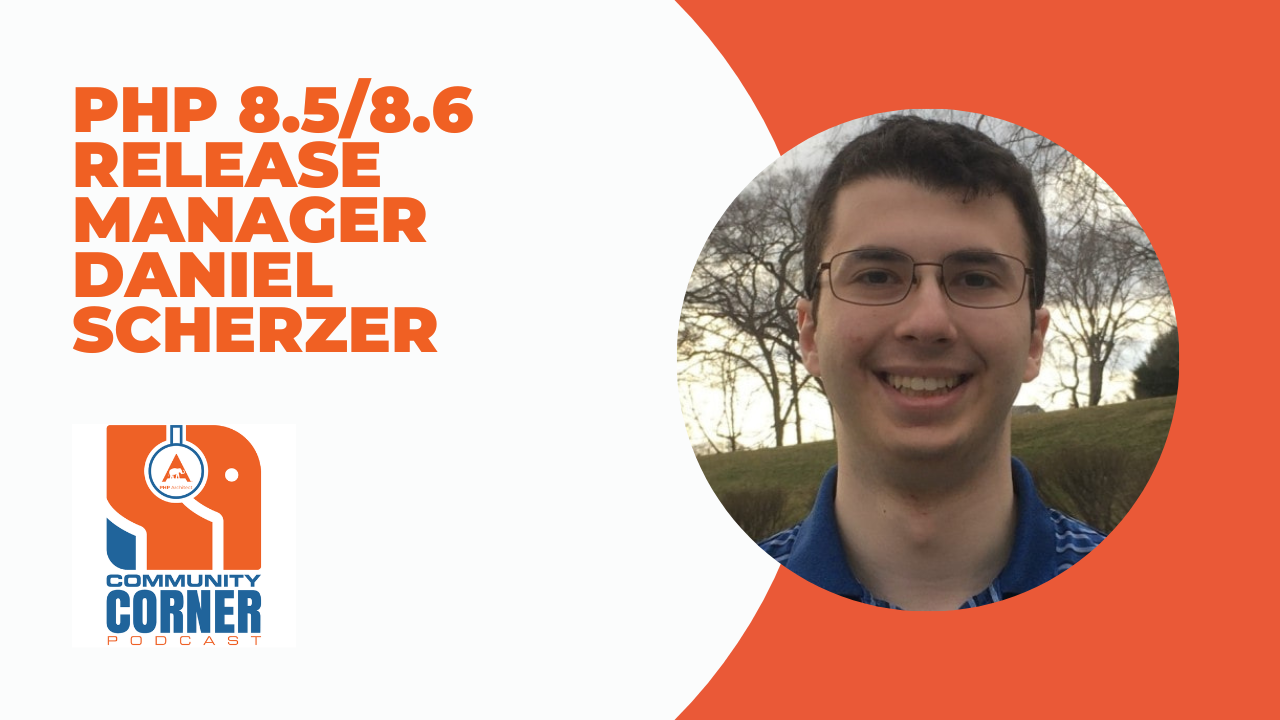
Hello developers, and welcome to the PHP Architect Community Corner, where we have conversations with members of the web development community. I'm your host, Scott Cack Warren, and today we're talking with Daniel Scherzer about his work on PHP 8.5 and 8.6, as well as his talks at Longhorn PHP this fall. Daniel Scherzer has been writing code for over a decade and is currently serving as one of the release managers for both PHP 8.5 and PHP 8.6. Check out his work at scherzer.dev. Thank you, Daniel, so much for finding some time to talk to us.
 Daniel Scherzer
0:36
Thanks for having me. Good to be back.
Scott Keck-Warren
0:39
Yeah, absolutely. Yeah, absolutely. So we last talked to you, um, in the fall, I want to say, of last year about your experience being one of the release managers for PHP 8.5. And we talked about that, I think, before we had done the release. Pretty sure it was before the release. Um, and so I'm just kind of curious, like, What has changed in that process for you since, since we talked to you last?
Daniel Scherzer
1:03
Well, it's, the releases are continuing. We're plugging along. Ideally each release has no big news in terms of, you know, nothing's breaking. There shouldn't be a lot of bugs that are fixed because there shouldn't be a lot of bugs. You know, everything seems to be going relatively smoothly. I wrote up a blog post a couple months back about one release that didn't go as smoothly. I think it was 8.5.6, where we ended up needing to have 3 release candidates. And so that was a bit unexpected, but nothing that I wasn't able to handle, and I wrote up my steps. and the decision-making process so that other release managers could use that as guidance for similar situations in the future, if there are any.
Scott Keck-Warren
2:00
Okay. So that's kind of good to hear. So, so essentially there's, there's not a, like a, you're not like doing an extra amount of work or anything like that. It's just kind of like plugging along with bug fixes as, as they get found.
Daniel Scherzer
2:13
Exactly. It's actually less work than it was. Before the release was officially available, before November of last year. Before November, there were questions of, is something going to break the stability of this release and is it too close to the initial release to include it? You know, we had a feature freeze and then a hard feature freeze and there was, there was, excuse me. And as a release manager, I was asked to chime in on if something was okay to include. Now that we're just in the normal bug fix release process, release managers aren't needed as much to chime in and say, yes, this is okay to include, or no, it isn't, because the general rule is that no new features are included in release branches. So 8.5 isn't going to have new features. It's only going to have bug fixes to the extent possible.
Scott Keck-Warren
3:16
Yeah. And I'm guessing that those are happening fairly infrequently, right? It's just like as they come up that you guys do those, or, or is there like some sort of a set cadence to bug fix releases?
Daniel Scherzer
3:26
There's a set cadence for the first 2 years, uh, 2 and a bit, because the initial general availability is in November. And then for December and the 2 years that follow, there's a bug fix release every 4 weeks with the release candidates on the, in the middle after 2 weeks. So it's release candidates today. I'm building for 8.5.10. 2 weeks from now, we will hopefully release 8.5.10. 2 weeks after that, the other release manager does A release candidate and then 2 weeks again before they cut their release for 8.5.11. And that's for the first 2 and a bit years where we do bug fixes on a regular basis. After that, there's 2 more years of security-only fixes, and those are as needed is my understanding. But I haven't gotten to that point yet with 8.5. Maybe in a year and a half, I'll have a better sense of how often those are really needed and what the time commitment is as a release manager for a security-only branch.
Scott Keck-Warren
4:41
Right. That'll be interesting to know about as well. So, and then, and so have you guys, like, has there had, guys is not right. Has there ever been like a point where you skip, um, like one of those, has there not been bug fixes to go out in some month or has that always, there, has there always been? constant bug fixes, essentially?
Daniel Scherzer
4:58
Not while I've been around. We haven't skipped anything. Um, I, I haven't looked into the history to see if there was ever a case, but the PHP project has enough people with the ability to merge changes that it seems like there's always something being merged and some fix being ready for the next release. And even if there wasn't a fix for the next release, I'm not sure that we would skip it. It would throw, I'm assuming it would throw off a lot of systems that expect a new release to be available every 4 weeks for each of the supported versions. That's an interesting question though. I will certainly keep it in mind if there's ever a week or 4 weeks when there are no new fixes and I'll discuss with the other release managers, do we want to skip it? But it's unlikely to happen anytime soon.
Scott Keck-Warren
6:01
Yeah. And I do think it's like a, it's healthy, right? Like it's healthy that we're constantly getting bug fixes into like the branch, the release branch essentially. Um, because that means that like people are fixing things and it's not just languishing for, for months and months, right? Like they're not so focused on new features that they're skipping over these things that are actually causing problems for people today. So I think that's definitely like to be applauded as part of the community.
Daniel Scherzer
6:25
Yes. The ideal would be that there's no bugs, but you know, any software as complicated as PHP is gonna have some bugs. Um, the, the second best is there are bugs and they are fixed promptly and released as soon as possible once they're fixed. We're not going to do a release every night or every week because that would just be too much work for both for the release managers and for end users to upgrade. But we also don't want, even when a fix has been presented, it to just sit there and wait for months on end. So I think the 4-week release cycle is pretty good for the bug fix releases.
Scott Keck-Warren
7:11
Yeah. And especially since like you can probably do a quick, like, let's get this bug fix out now if something critical comes up.
Daniel Scherzer
7:17
Yes. So the release process to determine which bug fixes are going into a release, um, is essentially those that are ready 2 weeks beforehand when the release candidate is cut, the first release candidate. So Today, in a few hours, is going to be the cutoff for what fixes go into 8.5.10. If over the next 2 weeks, we discover that there is a big problem that needs to be addressed or a security fix that hasn't been disclosed publicly, but should be included, then if for a normal bug fix, that's important enough, it'll be cherry-picked to the 8.5.10 branch. Okay. And then I will likely cut another release candidate. Or for a security issue, I will be told in the days leading up to the actual announcement. And then when I build the eventual 8.5.10 release, it will include those security fixes. I'm not sure what the procedure would be if a critical bug was discovered the day after it was released. Um, I mean, obviously we hope that never happens. My guess is that any such bug that is critical enough to warrant addressing probably would be caused by something that was new in that release. Ideally, releases don't introduce new bugs, but the odds of someone discovering a critical vulnerability that has existed for a while and they only discover it the day after a release is cut. Let's hope that doesn't happen. So my guess would be that we would just tell people, we being the PHP developers and people being everyone, that, hey, this new release has some issues, consider not upgrading for another 4 weeks until 8.5.11, for example. The fact that we have a consistent schedule for when is the next bug fix release going to be out means we could tell people, hey, there should be a version with this fixed in 4 weeks. It's not a question of, okay, how long do I need to wait?
Scott Keck-Warren
9:44
And I do have to say like, thank you from like our perspective for doing this, because this is obviously not like a paid position, right? So you're doing this out of the kindness of your heart. It's not, you're not doing as your job, essentially. Um, so we'll be right back after this word from our partners. As a programmer, you know that code reviews are critical, but are also time-consuming. CodeRabbit acts as your AI copilot, providing instant code review comments and potential impacts of every pull request. Beyond just flagging issues, CodeRabbit provides one-click fix solutions and lets you define custom code quality rules using AST grep patterns, catching subtle issues that traditional static analysis tools might miss. CodeRabbit reviews 1 million pull requests every week across 3 million repositories and is used by 100,000 open source projects. CodeRabbit is free for all open source project repos. Get started today at phpa.me/coderabbit. That's phpa.me/coderabbit. And we're back with Daniel. One of the other things that's kind of changed since we talked to you last is you're, you became like the veteran release manager for 8.6. So can you talk to us a little bit about like how that's different from being, I think it's a rookie, right? A rookie release manager.
Daniel Scherzer
10:58
Yes. Those were the titles that were used at the time. I think there was an RFC that changed those titles moving forward, but I still consider myself the rookie release manager or one of the rookie release managers for PHP 8.5 and the veteran for 8.6. And it's certainly been different. I'm not the one who's actually making the releases every 2 weeks or 4 weeks, but I am there to answer questions. This morning I saw a message asked from the developer, from the release manager who was creating beta 1 today about what to do if someone has Merged a change between when they started the process of tagging beta 1 and when they were ready to upload it. Now, because they had already uploaded the beta 1 tag, it was too late to just restart the whole process with that change incorporated. If they hadn't uploaded the beta 1 tag, that would've been an option. I think I did that at one point when I noticed a new change relatively early in the process. But the guidance I gave was, hey, you've already tagged beta 1. Any changes that merged after that tag, even if they merged before you announced the tag or updated the news file to reflect the tag, those all go in the next version. So the history will look a bit out of order. In that there was a bug fix for when the news file still said beta 1 is next. And then the news file was updated to say that beta 2 is next, but that bug fix will actually be part of beta 2 because the process had already gotten to the point where there has to be a cutoff. There has to be, you know, okay, we're done with the new fixes that are going to be included. or the new features that are going to be included in this beta tag, the same way there needs to be a cutoff for the bug fixes that are included in the week, the periodic bug fix releases. So yeah, like there's a cutoff and the changes that are available after that will come next time.
Scott Keck-Warren
13:28
Yeah. Essentially tags are immutable, right?
Daniel Scherzer
13:31
That's the goal. Yeah. Yeah.
Scott Keck-Warren
13:35
Yeah. Um, and, and so are there any features in 8.6 that you're really kind of excited about?
Daniel Scherzer
13:40
I think the biggest one is partial function application, the ability to specify, okay, here are some parameters for this function call. Now create a closure that will take the remaining parameters and apply the function so that you could, you know, build up your function call as you go. Um, it's been a while, but I think this is similar to currying in more functional programming languages where you can say, okay, here is a function that takes 2 arguments. I'll only pass in the first one, and now I just get a function that takes the one remaining argument. I'm not sure if currying supports arguments being provided out of order, but partial function application in PHP does. And that is something I'm very much looking forward to being able to use to simplify a lot of the code that I write for fun. You know, the pipe operator was nice, but that only works when the function takes a single argument. So if you wanted to use that for a function that takes 2 arguments, even if you know one of the values ahead of time, You would need to create an anonymous function inline that just says, you know, let's take this one argument and call the function with that provided argument and the known value. And I think PFA is gonna simplify that kind of code significantly.
Scott Keck-Warren
15:12
That'll be interesting to see as well, for sure. Um, and so I guess. I know that like coming up, you're going to be speaking at Longhorn PHP. Um, can you give us kind of like a brief overview of what it is you might be talking about there?
Daniel Scherzer
15:27
Sure. So my talk is going to be about what's new in PHP 8.6. The biggest thing is going to be the language change for partial function application. There are also some other language changes. I think I saw earlier today. Was when the implementation for default values for read-only properties was merged. There's also changes to what you could call the standard library. The URI extension has some improvements, and I, I've seen some others that I'm not remembering off the top of my head and also don't want to give away the entirety of my Longhorn talk. But yes, I will be giving a presentation about what's new, the new language features, library features, and some deprecations that were recently approved and have started being merged.
Scott Keck-Warren
16:26
That definitely sounds interesting.
Daniel Scherzer
16:28
I'm separately also presenting a workshop about creating PHP extensions. That was actually how I got my start in internals, in understanding the development of PHP. I wrote an extension called Custom Cast to support casting objects to integers, floats, and booleans in a user-defined manner. Instead of saying every object is considered truthy, you could now add a magic method that would provide the functionality of how exactly do you want to convert this object into Boolean the same way you can with the toString method. Now, that's really fascinating. It was an interesting project. Um, I'm, I don't think it's been used by anyone. It certainly wasn't perfect code, but that's how I got interested in the development of the internal language or the internal implementation of PHP. And Up until a few months ago, that was the only extension I'd written from scratch. Since then, I rewrote the reflection extension in Rust. So I built it from the ground up, but with the existing suite of tests and looking at the current implementation just as a learning exercise. And then I started working on an extension in Rust to allow interacting with Git repositories. And that is what I'll be walking through at Longhorn, how to build extensions in Rust with this example of an extension that interacts with Git, because the goal is for the functionality of the extension to not be the confusing parts. And I expect that most developers in a conference like this will be familiar with Git and will understand what a commit is and what a branch is. And so the focus can be on implementing things in Rust and how extensions are created rather than all of that plus how does the extension work? What is it supposed to be doing when, like, what is a commit?
Scott Keck-Warren
18:51
Right. It's, it's fascinating to me, like how, 'cause it used to be you, in order to write an extension, you would be writing it in C and now like you can, seems like Rust is the default. It's just like, okay, we'll just use Rust because it's way easier to work with and it still compiles down into C. So it's, it's, it's like always great to see that, especially since the C code is always so hard to follow. Um, so yeah, I'm, I'm a, I'm a big fan of, of that concept.
Daniel Scherzer
19:17
I, I agree that there are benefits to Rust and the C code can be hard to follow at points. I want to push back on something you said, which is that the Rust code compiles down to C. Yeah, I'm sorry. It compiles down to— it compiles down to binary or assembly, depending on how far in the compilation you go, but it is compatible with C. Um, the, the points of that interaction between the Rust and C though are a bit tricky with a project like PHP. And so there is an argument that it's simpler to write extensions in C because you don't need to think about the cross-language interactions the same way. On the other hand, you don't have the benefits that Rust has of, you know, pattern matching and macros to deduplicate things. Hygienic macros where they can actually process things in a more intelligent manner than just replacements the same way C macros do. So yes, you can definitely write extensions in C. You can also write them now in Rust. There's at least one extension I know of written in C++ because it's in tree. It's, I think, the internationalization extension in the PHP source repository. So there are multiple options. You don't have to learn a new language. in order to implement your extension.
Scott Keck-Warren
20:51
So, and unfortunately I do have to draw our talk to a, to a conclusion. Um, is there anything you wanna direct our listeners to before I let you go?
Daniel Scherzer
20:59
Nothing comes to mind at the moment. Uh, PHP is always evolving and I'm lucky enough to be on the forefront and with a front row seat to see all of those changes. For those of you who will be at Longhorn, I look forward to discussing what those Those changes are going to be for 8.6. And for everyone else, I hope you enjoy the new features in the language. And if you're not upgrading, enjoy the stability that 8.5 should be providing you.
Scott Keck-Warren
21:33
So thank you again. I really do appreciate your time.
Daniel Scherzer
21:37
Thanks for having me.
Scott Keck-Warren
21:39
I have to say another heartfelt thank you to Daniel for all of his time, as well as for you for listening. If you're not already a subscriber, make sure you subscribe with whatever your preferred method is so you can get the episodes as soon as they're released and maybe share this post with a coworker so they can learn from it as well. I should also mention Daniel has a personal website, which I put in the description, and he's currently looking for a PHP job. So if you know of a PHP job that you would be suited for, please contact him about that. This is Scott Keck Warren for the PHP Architect Community Corner signing off and reminding you to keep listening, keep coding, and keep reading.