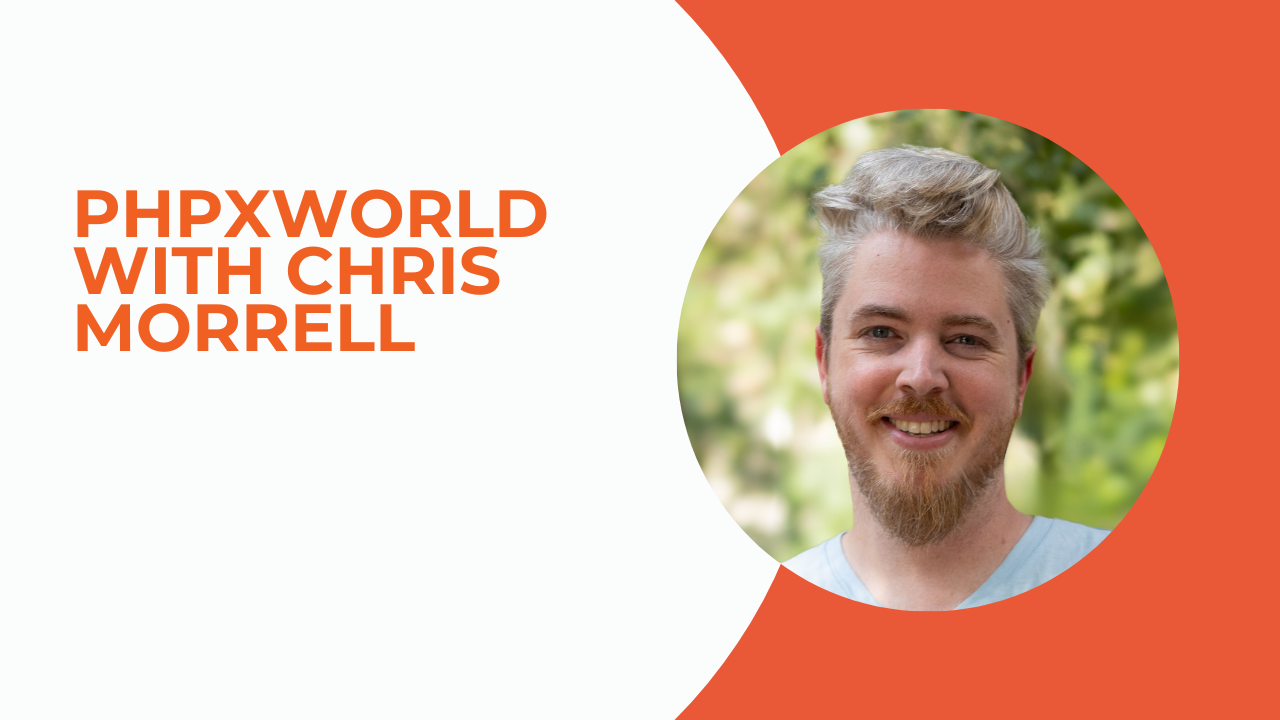
In this episode, Scott talks with Chris Morrell about PHPxWorld and a hopeful return to in-person User Groups.
Links:
PHPxWorld - https://phpx.world/
Chris on BlueSky - https://bsky.app/profile/cmorrell.com
HoneyBadger.io - https://HoneyBadger.io
00:00 Intro
00:33 What is PHPxWorld?
14:25 HoneyBadger
15:16 Being an Organizer
21:50 Outro
Transcript
 Scott Keck-Warren
0:04
Hello developers, and welcome to the PHP Architect Community Corner, where we have conversations with members of the web development community. I'm your host, Scott Keck Warren, and today we're talking with Chris Morell about PHPX World. Chris Morell is a father, the CEO and CTO of the International Association of Certified Home Inspectors, and an avid open source contributor. He is building tools to help home inspectors for 25+ years and tries to contribute as much work— of his work back to the open source community as possible. Thank you, Chris, for finding some time to talk to us today.
B
Speaker B
0:33
Hey, Scott, thanks for having me.
Scott Keck-Warren
0:34
Absolutely. So I think you've come on my radar for a couple of reasons recently, but the most recent one is your work in trying to bring back in-person conference or user groups. Can you talk to us a little bit about what you've created and how that's going?
B
Speaker B
0:48
Yeah, absolutely. You know, I think that for— I think that during the pandemic, one thing that kind of kept me sane was really embracing the PHP and Laravel communities on, you know, on Twitter at the time. I think that, you know, just not being able to spend a whole lot of time with friends put me in a position to maybe get over a little bit of my discomfort in reaching out to people that I didn't really know very well. And I made some good friends that way. And So I think that when things started to open up and I started to go to events, most notably Laracon, it felt very different because it was like getting together with a bunch of friends for the first time. And I kind of walked away from that just really feeling like, I don't want to wait a whole nother year for this to happen again. And so that kind of like sparked the idea. All right. We used to have a really great user group in Philly, the Philadelphia PHP, or yeah, Philly PHP. But the fellow who ran it, you know, moved outside of the city and things kind of slowed down. And it, you know, I don't know if the pandemic was exactly the killing blow. I think it maybe ended before that, but I don't think it would have survived the pandemic if it had made it to it. And so, you know, I reached out to a couple of friends. about like, let's, let's try to get something going on again. And at first we were kind of thinking about, okay, do we want to do like affiliate open source, uh, something like that's a little bit bigger? Um, but as I was having those conversations, my friend, uh, Joe Tannenbaum, uh, started PHPX NYC. Um, and when I saw sort of what he was doing there, I was just like, okay, this is a no-brainer. Like, as long as Joe doesn't mind me kind of hopping on that name, like let's, let's call it PHPX Philly. It just felt, it felt right. It felt like it kind of hit that sweet spot of being open to the whole PHP community, but not trying to be more than, than a PHP user group. And so that was kind of, that was kind of where things started was going up to New York to a couple of the New York City meetups and just getting a small group of people together here over a couple of months. What happened was we had these 2 meetups, and when I built the PHP Philly website, I thought, all right, well, let me do this as a multi-tenant app. That way, if Joe ever wants to join forces, we can. I knew he was using Mail Coach, so I I was like, all right, I'll build it using Mail Coach so that we can kind of join forces there. And, you know, just sort of thinking a little bit about that piece. But I was on Bluesky and I can't remember who it was first, but I just saw kind of across my feed someone saying, oh, I want to start a PHP meetup, maybe even saying something about PHPX. And I was like, well, if you want to point your domain at this IP address, like it's already ready to go, I'll just add you to the database. And over the course of the next like 3 days, I think 12 meetups started up. It just kind of— I didn't have any intention of kind of being this ambassador for like this new era of PHP meetups. But when it started to happen, I just, I I just thought, yeah, I mean, I really, really want to see the in-person PHP community come back. I know that there are cities where it never went away, but in my experience and the experience of a bunch of other folks, it really did disappear for a while there. And so, you know, I've just been kind of trying to do what I can to facilitate that.
Scott Keck-Warren
4:59
Yeah, and that's really awesome. Definitely. So I went to Cascadia PHP, which was last month or the month before. And there actually, one of the talks was about how like there was, there is this very clear delineation between pre-pandemic and post-pandemic. There's just all these things that have just like become dormant because of like across that line. Right. And it's, it's a question mark of why, but, you know, probably the pandemic. So, you know, I mean, there's a lot of things where we can go like, it was probably the pandemic that did this and not just like random. So that's, that's all like really, really Like, it's great. Like, I don't think anybody ever goes, I'm gonna be this person, right? It just kind of like happens. And so it's like great that you're like willing to take that mantle on. Is there— so what is the distinction of like the PHPX? Like, does that mean something in particular or?
B
Speaker B
5:44
Not really. I mean, I think it's just, you know, like, it's a brand, as it were, that people are kind of rallying behind. I think know, it just kind of hit at the right time. I think that, um, you know, Joe really, he went with a pretty minimalistic look, but he had like a, a real aesthetic that he was going for with the NYC website. And I kind of like ran with that and just went with this sort of, uh, you know, monospace, but nicely designed, uh, look and feel. And so I think that, I think that folks just kind of thought, all right, This is, this is like a cool thing that looks good and feels good. Like, let's all kind of rally behind that, um, and sort of take advantage of the fact that it's almost becoming its own brand. You know, we kind of all get to, uh, you know, benefit from that in terms of finding, you know, folks who maybe can support in terms of sponsorship or folks who might know about, um, you know, space that, that we can host events at. Those are kind of the 2 big challenges when you're starting up a meetup. Or the 3 big challenges really are, you know, money for food and drinks, space, and speakers, right? And not every meetup has to have a speaker every time, but it certainly helps. And so the sort of next phase of PHPX is trying to find ways to really pool resources around those 3 things to make it easier for different organizers to find you know, find space. Maybe the exposure that the whole PHPX network gets will make different groups that do have a big conference room or a local company might hear about it. Maybe they didn't hear about the individual meetup, but they might hear about the network and be able to reach out and offer a space. Or a company that maybe has offices around the country, they could say, Yeah, we want to host these, you know, like that's what I'm hoping for.
Scott Keck-Warren
7:50
Yeah, that's really cool. And so like, as it, so like if somebody is already, uh, so let's, let's talk about this from the perspective of like somebody who's interested in going to a user group, right? So you can go to the php-x.world website and it'll show like all of the different cities that have been affiliated with, with what you've got going on. And is it, and is it just kind of like find what you like and then sign up for the mailing list? Or what's close to you, I guess, in the sense of the mailing list?
B
Speaker B
8:15
You know, that is, that's sort of the entry point, phpix.world. And, you know, you just hit the menu bar and it's going to show all the different user groups. You know, I've built it so that we can host the meetup website, you know, sort of basic RSVPs and mailing lists, or we can link out to an existing site because I want to make sure that you know, all the groups that already exist can also benefit from like this little wave of exposure that this thing is getting. Um, so probably, you know, 2/3 of the items in that list are going to be sites that are hosted by, by me. And then the other third is just linking out to existing user groups. So it's not like a— I'm not trying to like enforce any sort of like uniform experience. I'm just trying to like provide some tools that make it easier. But for the most part, yeah, like right now, I would say for anyone who's interested, like, go to the website. If there is a group, go ahead and sign up for the mailing list. And, and then like, right now, a lot of the organization is happening on the Discord. So there's going to be a link to the Discord from any of the PHPX websites. And yeah, I think that right now, there are a couple places that have had meetings or, you know, have actual meetings planned. But Like if you can get involved, just even if you're not going to organize, just like telling the organizer, yeah, I will definitely come. Like, I'm, I'm a person who's interested in seeing this happening, uh, really can make it a lot easier because it's, it's a lot of work to organize these events. Um, and you want to know that there's at least going to be a couple of people who show up, you know.
Scott Keck-Warren
10:00
I've started doing like conference talks. Like I've started going to conferences and talking at conferences. And it's really nice because like I see like the same, I have like that same thing where like I see the same people like at the different conferences and like they become like my conference friends, right? And so I have like these people that I like see a couple times a year, but like I do want that, like I want to have that sensation locally, like every month, you know, it'd be nice to have like that kind of feedback. And so what, like, so I live in what I call a user group desert. There's like the closest conference to me or the closest user group is in Chicago, which is a 5-hour car ride, which is not something I can just like go to. And so, what would I have to do as just like regular Joe Blow to get myself set up so that I could, you know, be a user group speaker through your website?
B
Speaker B
10:49
Yeah. I mean, right now, it's pretty informal. I think that like, over time, as things sort of solidify, we may need to, you know, think about policies in terms of like, who can start another meetup within the same region of each other so that we're not having tons of overlapping competing groups. But I don't think we're anywhere near that yet. So literally you go buy a domain. There's a document, it's just like a markdown file that gets rendered on phpx.world/organizers that walks you through the process. Essentially, it's a pull request to the open source repository that is the website. And when you submit that PR, we have a— like, I just have a test that runs in CI that checks, is this domain registered? Is the JSON formatted properly? And if it is, it passes and I hit merge. And when I hit merge, it will just sync that new meetup into, or that new group into the database, it actually automatically connects to Laravel Forge and adds the domain to the Forgebox. So like literally I hit merge and now you have a working website. And I've kind of laid it out. So there's like, there's prospective user groups, there's pending user groups, and then there's active user groups. So you would probably just start out as a prospective user group, which all that means is your website says like, hey, we'd love to get something going, like get on the mailing list and join the Discord to like rally around, rally around seeing this happening, you know? And a pending user group is essentially just like, hey, we're planning the first meetup, stay tuned, right? So that's, that's kind of the extent of it right now. Like I said, I really want to figure out, and it just comes down to finding time. I really want to figure out, you know, ways to make it easier to find sponsorship, to find venues, and to find speakers that you're a little bit on your own for right now. Although I am in active conversations with a couple of like big players in the PHP space that like are very interested in supporting this stuff and seeing it happen. So there will be some resources there, both on the sponsorship and on the speaker side, within the next couple months, probably by mid-February, I think. So yeah, that's kind of the process right now. It's pretty low-key. You're still organizing your own group, right? I'm trying to make it as easy as possible to get a basic website with RSVPs live and get you a mailing list. And actually, our friends over at Mail Coach sponsor a mailing list for every group. So like you can, once you sign up and get on the Discord and get set up as an organizer, I'll get you access to a free Mail Coach account so that you can do— mailings out to the, you know, everyone who signs up. So there's a little bit there in place. But otherwise, then, yeah, you just got to start finding a venue and try to get connected with some folks who want to show up.
C
Speaker C
14:23
Do you want higher clarity in production but don't have the time to earn your degree in observability? Me too.
Scott Keck-Warren
14:31
Forget logs, metrics, and traces. Honeybadger Insights is built around structured events. When you send your application logs and other events to Honey Badger, you'll unlock the power of Honey Badger's powerful new querying language, BadgerQL. You can then use BadgerQL to ask any question about your data, convert any event into a metric, and chart your metrics on a custom dashboard. You can do all of this on Honey Badger's free plan as part of their comprehensive monitoring suite, which includes error tracking, uptime monitoring, status pages, and more. Speaking of error tracking, did you know that an error is really just a first-class event in Honey Badger? In fact, you can use Insights and BadgerQL well to explore all of your existing Honey Badger data in new ways. It's pretty cool. Give it a try today at honeybadger.io. That's honeybadger.io. So I'm going to do this, right? Like my goal is like in 2025, there's going to be like a user group that I can go to. And so, so I just, I'm trying to figure out like how to do that. Um, so I do appreciate like, like you were like the, uh, impetus for, for me to go out and do this. I'm like, I should just do this. Cause I've been talking about it for a couple of years. Like I was like, I should do that in like 2020. And then the pandemic hit and I was like, oh, this is your bad year. You know what I mean? And so like, it was just kind of like, I've slowly been going like, oh, I need to do this. I need to do this. So I'm definitely like, I'm going to reach out and like, look, read through all the documents and try to set this up and, and get that going, at least as a perspective thing. Because I think like ultimately to me, the hard part is like, I live in not a metropolitan area. Like I live in, I live in like a, you know, a smaller, like more rural area. Um, and so it's, it's, I didn't even, I was like, where do I even, how do I even find people to be interested? But this sounds like it's an excellent way to at least get that conversation started. So yeah, thank you. I appreciate it. Yeah,
B
Speaker B
16:07
yeah, yeah. And there's, you know, there's a, I'd say, a growing group of people on Blue Sky that are like sort of actively supporting each other's endeavors in this space and like promoting each other's events. And I think that that's, you know, I don't know that that's going to get you a critical mass of people, but it gets you a little bit of extra exposure in the beginning, at least for sure.
Scott Keck-Warren
16:32
Right. Even, and even if it's like, just not me showing up, right. If, you know, if there's like, if there's 2 people, it would be, it would be worthwhile as far as I'm concerned. So yeah.
B
Speaker B
16:39
I mean, to be fair, like the first PHP Philly meetup was 3 people in a pizza shop, you know, um, that was, that was the entire meetup. Uh, and then the, the second one was 6 people in a friend's office. Uh, and the third one was like 25 people in that same office. So like, I think it's been all over the place for us. And then the following one was back to 7 or 8 people. So it's been a little bit of like a— I don't know what the magic of that 3rd meetup was. I think perhaps it was having a formal speaker, which is something that I'm trying to figure out. And I'd like to sort of provide some resources here too around— we've been doing— we've had speakers. We've had— the most recent one was a show and tell, which was really fun. Anyone who wanted to just could get up and just walk the group through a project that they're working on. Most of them were PHP, but one guy showed off a Swift app that he was building. He's never done any desktop development and just wanted to try it and kind of showed us what working in Swift is like. I talked about a Blue Sky Labeler project that I'm working on that's all in JavaScript. So like, it was kind of like whatever you want to show that you think people would be interested in, go ahead. And that's been a really fun format for events. And then we're also talking about doing more like social, like out of an— out of a conference space social events. Maybe do an escape room together or go bowling or something, you know, like just, uh, uh, find other ways to meet as a group and socialize.
Scott Keck-Warren
18:26
I think ultimately like the part that I always find interesting about the user group concept is it's like part learning, but also part like ment— or, um, networking. Right. And like just having like that, that space where you can have other people. Cause like in my area, the other PHP developers that I know work with me. Right. I mean, like that's the reality is like we all, we are already like a group, but there's more of us out here. I'm sure it's just. trying to find those people and, you know, networking with them.
B
Speaker B
18:50
Yeah. Yeah. Well, that's what— when I was, when I was first talking about PHP Philly, you know, I got together with a friend of mine who is, you know, runs a Drupal shop. And we were just talking about it. And I just said, like, you know, standing right where we are right now, I feel like I could throw a stone and reach where another PHP developer is, right? Like, you know, it's, it's, there's a lot of us out there and in a, you know, in a big city like Philadelphia, there's, there's just gonna, there's gotta be a critical mass, but everywhere, you know, there are PHP developers. It's, it's, you don't remain the most popular web language and not have people working on it, right? Like, just is what it is.
Scott Keck-Warren
19:37
Right. Even, even, you know, like there's some, somebody who's writing some line of business application for some small company that's a PHP developer, like everywhere. Is there anything else you'd like to direct our listeners to before we say goodbye for today?
B
Speaker B
19:48
No, I mean, I would say check out peachpx.world. And, you know, join us on Bluesky. You can find me on cmorell.com, all my different socials. But I really am only spending time on Bluesky these days. And yeah, that's about it.
Scott Keck-Warren
20:11
Yeah, I feel like Bluesky is like a really warm fuzzy blanket. Like it's, it was, it was like a really nice, like getting into it has been really nice. It was, I just like resisted like another social media network for a long time. But man, it is a nice place to be. It is a nice—
B
Speaker B
20:25
Yeah, I will say, I mean, I think we're, we're, I think we're starting to feel some growing pains, or we're starting to feel the very beginnings of growing pains. Not that that really is an issue yet, but I can kind of see it becoming like, like anything, you know, as you grow, you, you have to figure things out. Um, but I think the, the fact that they introduced those starter packs made it so much easier to switch over because you're not like starting from scratch. You know, you can go on there and say, like, I'm looking for Laravel developers. And there's just like a bunch of really great starter packs where you can find Um, you know, like I run one that's like automated that show— that automatically adds anyone who's contributed to any of the Laravel repositories. Um, you could just like click follow all if you want to, or at least like scroll through that. Um, and, uh, Justin Jackson runs another Laravel one and a bunch of like, you know, business and podcast starter packs. So like whatever you're interested in, that's such— it just makes it so much easier to switch, you know? Yeah. And, you know, it's a new platform, but they got a lot of really good things right. And there's a lot of really interesting concepts there. And I think it's, yeah, it's been a really fun place to be in the last few months.
Scott Keck-Warren
21:44
Yeah, absolutely. And so thank you. It was nice, really nice talking to you today.
B
Speaker B
21:48
Yeah, you too. Thanks for having me.
Scott Keck-Warren
21:50
I have to say another heartfelt thank you to Chris for all of his time and for your time as well for listening. If you're not already a subscriber, make sure you subscribe with whatever your preferred method is. There's a video version on our YouTube channel, as well as an audio version on the PHP Architect website. And maybe if you decided you're going to be your own organizer for a meetup, let me know as well. I'd love to know if we've, we've had some sort of an impact with, with all of this discussion. This is Scott Keck Warren for the Community Corner podcast, signing off and reminding you to keep listening, keep coding, and keep reading.