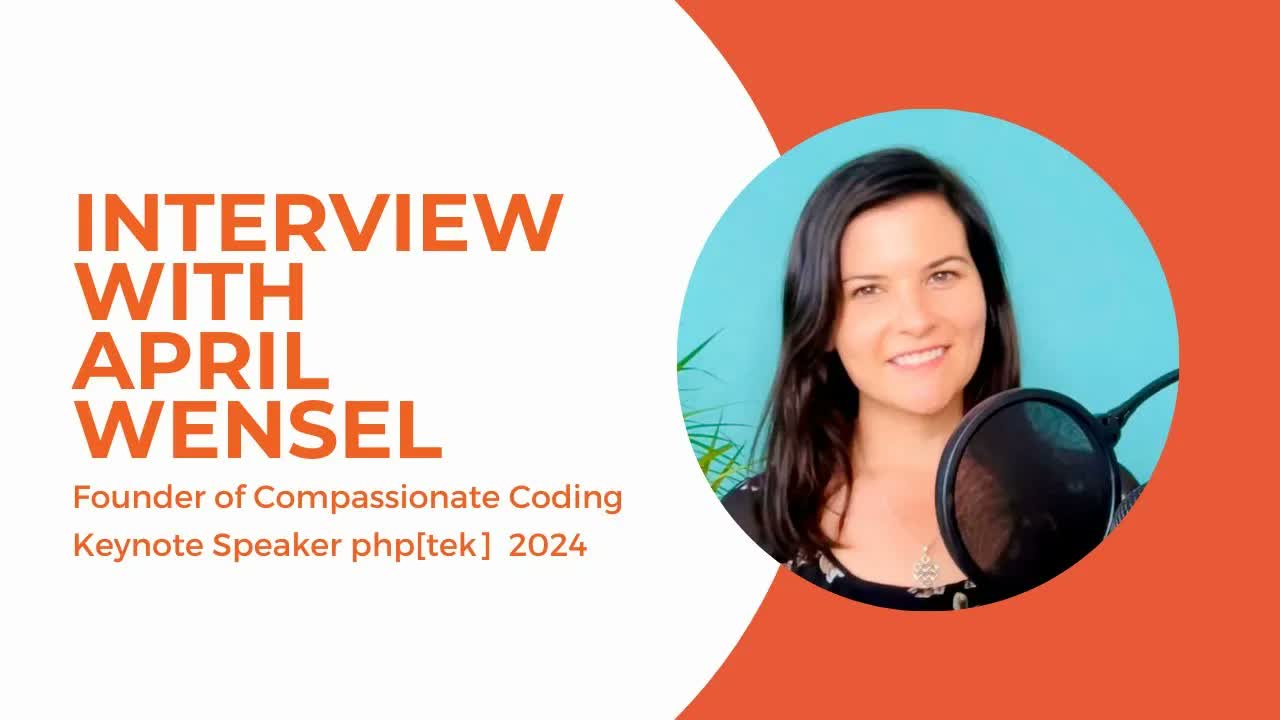
In this video, Scott talks to April Wensel from Compassionate Coding about empathy in coding and her keynote at php[tek] 2024.
Links:
Compassionate Coding - https://compassionatecoding.com/
Tickets to php[tek] 2024 - http://tinyurl.com/tek-2024-tickets
00:00 Intro
00:55 What is Compassionate Coding?
02:24 What is Empathy?
07:07 The Importance of Soft Skills Talks At Conferences
10:41 php[tek] 2024
11:37 April's Talk at php[tek] 2024
16:14 Outro
Transcript
 Scott Keck-Warren
0:04
Hello developers, and welcome to the PHP Architect Community Corner, where we have conversations with members of the web development community. I'm your host, Scott Keck Warren, and today we're talking with April Wenzel about Compassionate Coding and her talk at PHP Tech 2024. April Wenzel is an international keynote speaker and founder of Compassionate Coding. A conscious business that trains technologists in emotional intelligence and communication skills. Prior to starting Compassionate Coding, she spent a decade in software engineering and technical leadership roles at various startups in Silicon Valley, building products in healthcare, gaming, education, and user research. Away from the keyboard, she enjoys gleaning fruit, running ultramarathons, and baking tasty vegan treats. Thank you. Uh, thank you, April, for joining us today.
 April Wensel
0:52
Yeah, thanks for having me. I'm excited to be here with you.
Scott Keck-Warren
0:55
Awesome. So, your business is Compassionate Coding. Can you tell us a little bit about what your business does?
April Wensel
1:00
Sure. Yeah. So, I started Compassionate Coding in 2016 after working in tech for about a decade, as you mentioned. I noticed that a lot of the problems we kept running into were not really technical problems per se, but rather human problems like communication breakdown, not really empathizing with the user. Burning out, all these, like, very human issues. And yet, a lot of times, talking about the soft stuff was kind of dismissed in tech. You know, even at conferences, it was like, oh, you know, we want technical talks, not soft talks, as if there's, like, a hierarchy. And so, I was like, okay, but, like, these are the two— these are two things that are happening, and, like, they go together. Like, the reason we have all these problems is because we don't talk enough about the human stuff. So, I was like, clearly, there's a business opportunity here. So, both because of frustration with these problems that I saw and also, like, inspiration to do something about it, that's why I started Compassionate Coding. So, what I do with Compassionate Coding is I teach emotional intelligence skills, but through the lens of software engineering and other, like, technical roles, so that people don't just dismiss it as, like, soft, fuzzy, like, nonsense, but, like, hey, this will actually make me a better developer. You know, even down to like naming variables with empathy and, you know, the architecture decisions we make and how that impacts people and kind of trying to come at that even from a compassionate, empathetic place.
Scott Keck-Warren
2:24
So, I think there was a lot to unpack there. Can we start out first by kind of talking about what empathy is? Because some people may not have heard of that before.
April Wensel
2:33
Sure. So, empathy, there's like so many different levels to discuss it because what people in tech don't always realize is like in psychology and this whole other field, like, and social science and everything, people take these terms and rip them apart and get really deep into it in the same way that we do with technical stuff and programming languages and stuff like that. But to not overwhelm people, empathy at a simple formulation is understanding what somebody else is feeling. And so there's some different varieties of it. Sometimes you feel it emotionally. If you see somebody— I'm sure some people have experienced this, where if you see somebody you know, hit their hand or get hurt, like you almost feel the pain a little bit. Like that's kind of one version of it where you're actually feeling it. Or if you're— if you see somebody really sad, sometimes you kind of feel it. Not everyone has a strong degree of that emotional empathy though. Sometimes it's more a cognitive version of empathy, which is kind of more perspective-taking, like being able to look at what somebody's going through and say, I bet they're probably feeling sad because they just went through this tough time, or I bet they're stressed And I can, you know, pick up on that because of their facial expressions or whatever. And so sometimes it's about like applying logic and trying to understand how people feel, and sometimes it's just an intuitive thing. And so different people have different levels of it, but you can learn to get better at both of them through practice. And so I like to especially emphasize that empathy is a skill.
Scott Keck-Warren
3:59
Empathy is something that I am not particularly like good at, right? Like it's something that I've had to learn as, as a, as a developer and as a manager. And because I'm really good at dealing with computers. And I'm not necessarily as good as dealing with people. And so I always have to try and, you know, before I send a message or before I send an email, go, okay, well, how is the other person going to interpret what I'm saying? Right. That's, that's applying like empathy, is trying as best as I can to apply empathy to, to the communication process.
April Wensel
4:28
How did you learn? I have to ask, how did you teach yourself or how did you— Yeah.
Scott Keck-Warren
4:34
Wow. That's a really good question. I think that like empathy is not something that I even knew about maybe 10 years ago. I don't know. I know that like it was a topic that I had not heard of. I didn't take many like psychology classes, I guess I should say. So it was all very much like hard technical stuff, right? And so someone said, well, this is a thing and it's important. And I was like, oh yes, it is important. I don't know how like that's not in like our like intro programming classes to understand all that pieces. Right. Because that's really like a gap in, you know, especially in the US, in, in computer science is just like, here's how to do the technical things, but not necessarily those soft squishy parts. Right. Um, and so I read some article about how it's important and then immediately just said, okay, well, this is like a cornerstone of being a good manager and being a good developer is making sure that you look at things through other people's eyes and see how they might like interpret what you're doing.
April Wensel
5:28
Yeah. And so did you, so reading articles, is that how you kind of taught yourself or, you know what I mean? Like, or was it, that was enough? Yeah. That's. That's good.
Scott Keck-Warren
5:37
Yeah. Unfortunately, there's never been any company that I've worked for where they're like, empathy is important, we should do a training on it. It's always just been like a self-learned type of a thing.
April Wensel
5:44
Yeah. Which speaks to the culture of the industry is that a lot of times these aren't valued. What I found is for years and years, companies have done leadership training sort of stuff. And so then it was like, okay, if you're going to be at a certain role, sometimes you'll have access to that. And that's at larger companies with more resources, not necessarily at smaller companies. But that I think these skills are valuable to individual contributors as well, because we still have to negotiate things. We still have to give feedback in code reviews. We still have to write code, like I said, and thinking about, you know, your users and your collaborators and everything helps you there. And so, I think it applies in so many ways, and yet, it's only, like you said, in recent years, I feel like, that it's been really valued. And so, that's also why I saw an opportunity for it, is that there's such a need, and it's not really being being addressed fully.
Scott Keck-Warren
6:33
I agree totally. And I think that like, as my— in my day job, we deal with other companies and the managers at those companies. And a lot of times, there's obviously smaller companies, and they have the same kind of just like, well, you were a good whatever, and now you're a manager. And then there's not really any kind of training for them. Like, that's especially been like my experience is like, as a person, it's like, well, I'm good as a contributor. So I might be good as a manager so then I can become a manager, but then there's no like, well, what's the support you need for that? You know, it's always just like, I gotta go figure it out on my own, essentially. So.
April Wensel
7:06
Totally.
Scott Keck-Warren
7:07
So, and I, one of the things I want to touch back on is you were talking about how like there's that lack of soft skill trainings at conferences and speakerships and things like that. And that is really like a huge gap, right, in talks and things like that. And I think especially from my perspective, like, There's a very much like a, okay, well, we want, we have a lot of people here who are new and they want to learn new things. And so that's going to be like the most bang for their buck is here's some new technology thing. Whereas those soft skills are still super important and we should be like even maybe splitting it 50/50, right? Like it should be 50% technical, 50% soft or some variation on that.
April Wensel
7:44
Well, and so 2 things on that. One is I think that especially for people new in the field, These quote unquote soft skills are more kind of, I see them as almost meta skills, because if you learn these skills, it helps you learn all those other technical skills. You know what I mean? So like if you're able to manage your own learning process, if you know how your mind works and the ways that like work for learning, if you know how to ask questions in an empathetic way, like that takes into consideration the time of the person you're speaking to, then you're gonna learn better. So these are actually skills that, like have very practical applications for even newcomers and also for people in the field. And then the other thing I'll say about this 50/50 is I also kind of don't think there is an easy way to draw a line between the soft and technical sort of thing. Like I try to, I'm also kind of trying to challenge that with my work because, you know, with compassionate coding, I just mash them together. So, but I really think that, you know, when people are, even when they're giving a quote unquote technical talk, like about how their team, you know, introduced this new technology and how it like changed, you know, how they started using microservices, how they, whatever it is. And then a lot of it comes down to how did they communicate this to the team? How did they get buy-in from the stakeholders? You know what I mean? And so those are all quote unquote soft things. And so I think sometimes too in tech, we see things in black and white binary, you know, I mean, it works in the code, not so great with humans. And so I think that being able to, to see the gray areas and how a lot of this stuff is connected, And so, like, even in my talks, like, sometimes I do show code samples and say, like, here's, you know, this is this compassionate code or whatever, you know what I mean? And so, I think that mixing that a bit too, I think, is kind of where the industry's headed. And I say this from witnessing this. I've been doing this for, like, 8 years now with my company and coming up on 8 years in May. And I've seen a shift. Like, I used to have to very much, like, convince conferences of the value or, you know, that sort of thing. I don't so much have to do that anymore. Like, now conferences are like, oh no, this is super important and we need this and please come speak about this. And you don't have to talk about code. Like, we just need to talk about the human. And I'm like, okay. Like, you know, so I think I do see a shift happening. And I think it's because, like how you pointed out, like awareness is building and people are like, hey, this stuff is important.
Scott Keck-Warren
9:59
I know, like Eric and John, who are the conference organizers, they were really talking about how, oh, we need more soft skill type talks, right? Like, I think last year there might've been a few, like a handful. I don't remember what there is, you know, this year, but I do know that like they are, they're aware that that's an issue and they're working on it.
April Wensel
10:16
Yeah. And they were being great about that. And I was even looking through some previous years and I saw there were talks about like courage and things like that. Just things that were more human-oriented, um, with still, you know, technical information, but very much human-oriented, which I definitely appreciate. And I've been seeing that at recent conferences as well, um, that the soft, the soft human stuff that, you know, is, is, is also a part of life. It's hard to avoid.
Scott Keck-Warren
10:38
We'll be right back after this word from our sponsors. Attention PHP developers. Did you know that one of the best ways to improve your skills is to attend a conference? It's true. And have I ever got a deal for you because PHP Tech is returning for another year of leadership expertise and networking all in one event. It's a relaxing atmosphere for tech leaders and developers to share, learn, and grow professionally while also providing you with the knowledge to solve your everyday problems. You'll learn Xdebug from its creator and how to write sustainable code. So join us April 23rd to April 25th, 2024, just outside of Chicago, Illinois, or online as all of the talks will be streamed live. If you can't make it during the conference itself, all the talks are gonna be available for you to watch later at your convenience. You'll even get access to last year's talks. Tickets are on sale now at tech.phparch.com or use my link in the description to get a discount. Now back to our video. And we're back with April Wenzel. You're going to be one of the keynote speakers. I think you're the first keynote speaker. Can you tell us a little bit about what you're going to talk about?
April Wensel
11:42
Yeah. So, you know, I always talk about compassion, but I like to approach it from different angles. And so one thing I've been thinking about a lot, especially in the pandemic years, is just how much change we all kind of went through and are continuing to go through. And whether it's from, you know, hybrid work or, you know, remote work or AI coming in and new AI tools and people, some fears around that. And just, you know, there've been a lot of layoffs in the industry and it just, there's a lot going on and there's a lot of change. And so compassion really helps with all of this because we need self-compassion. We need compassion for other people as they're going through these changes, especially, you know, difficult changes. And so What I'm gonna be speaking about is how to embrace change rather than fearing it in hopes that it will help people avoid burning out because I see a lot of, or deal with it if they are already burning out, because I think all this change, you know, is a lot to deal with. And people, I look around and a lot of people are very tired and like, you can see it in Zoom meetings. You can see it, you know, just all around, like people are just kind of tired. And I think part of it is, it's just, it's a lot for a human being to deal with the level of change that we've been having to deal with. And so, yeah. Yes, I'm going to try to do what I can to show people how to do that. And so I think it'll have applications for people on an individual level in their career in terms of how they look at change and how they handle change. And also if they're leaders in their company, like how they lead their teams through change, because again, that requires a lot of compassion. And I'm also going to be talking about curiosity and creativity and how they fit in as well. So it's going to be 4 C's, I guess, there: change, curiosity, creativity, compassion. I like alliteration, as you can tell from my company name, Compassionate Change. passionate coding. So yeah, it should be fun and should be exciting.
Scott Keck-Warren
13:35
Yeah, I'm really looking forward to it. I, I actually didn't know that your business existed until you showed up as one of the sponsors. And then I was like, oh, this is an important thing. You know what I mean? Like, I was like really interested in talking to you about all this stuff.
April Wensel
13:46
Aw, thank you.
Scott Keck-Warren
13:47
Yeah. Especially since like that is an important piece of, of our industry, right? Is like, we're always changing things, right? Is like even 10 years ago, You know, like we're PHP. PHP is significantly different 10 years ago than it was today. So we have to embrace that change. We have to be always on the bleeding edge and it is stressful, right? And so we have to figure out ways that we can kind of take that in stride. Can you talk to me a little bit more about like what the creativity piece will be to that? Because I know that as someone who values mental health, like having a creative outlet has been helpful for me. Is that kind of what you're going to be talking about or? Is it something else?
April Wensel
14:25
Yeah, that's one angle. And it's also like how we look at the change, you know what I mean? So creative angles of interpreting the change so that, you know, because when you're a little more flexible in terms of how versus being rigid in terms of how you deal with change, especially like unexpected change, can help you navigate, right? So I think creativity is an important piece for charting the path forward as you have like all this uncertainty happening. And so it fits in in that way too. But yeah, definitely what you said as well, creative outlet very much helps. And I think, you know, that's something too that like people in tech may say in the same way they may say, I'm not a people person. I work, you know, work with computers, right? People often say, oh, I'm not creative. I just do, you know, computer stuff. But like the work we do is immensely creative. You know what I mean? I mean, whether it comes down to like, you know, getting the constraints from our stakeholders and then trying to figure out a creative solution that like helps, That's creativity as well. And so, I think also I'm going to kind of try to help broaden people's view of what creativity is and how it does apply to the work that we do as engineers.
Scott Keck-Warren
15:30
I mean, I'm really looking forward to it. It sounds really like it was going to be an amazing talk.
April Wensel
15:34
Oh, thank you.
Scott Keck-Warren
15:35
Yeah, absolutely. Is there anything else that you want to direct our listeners to before we let you go for today?
April Wensel
15:40
Sure. So, if people want to stay in touch, I'd recommend they subscribe to my newsletter. So, they can find it at compassionatecoding.com. And there's a signup link there. And I'm not— I send one out about every 2 weeks, but, you know, and so it's not like gonna spam anybody. And it's just, you know, thoughts on these issues about the human side of tech and with little, you know, nuggets on things that they can apply to their day-to-day. And that's a good way to stay in touch, I feel.
Scott Keck-Warren
16:09
That's awesome. I'm gonna sign up right now.
April Wensel
16:10
Yay! Thank you. Great speaking with you.
Scott Keck-Warren
16:15
Yeah, and thank you for your time today. I have to say another heartfelt thank you to April for her time and for your time listening today. If you're not already a subscriber, make sure you subscribe with whatever your preferred method is so you can get episodes as soon as they're released. Maybe share this post with a coworker so they can learn from it as well. This podcast is available both in an audio version on the PHP Architect website as well as a video version on our YouTube channel. This is Scott Keck Warren for the PHP Architect Community Corner. Signing off and reminding you to keep listening, keep coding, and keep reading.